The baptismal formula that is most closely identified with the Trinitarian tradition is typically rendered in English as I baptize you in the name of the Father and of the Son and of the Holy Spirit. This wording foregrounds a belief in the three equal persons of the Godhead who are invoked at the moment of Christian initiation. The roots of this practice are found in scripture, patristic testimony, and liturgical development that unfolded over the first centuries of the church.
Central to the justification of a Trinitarian baptism is the Great Commission in Matthew’s Gospel. In Matthew 28:19, Jesus instructs his followers to baptize “in the name” (singular) of the Father, the Son, and the Holy Spirit. The language of name in the singular emphasizes the one true God who reveals the threefold reality as Father, Son, and Spirit. Early Christian interpreters understood this instruction as a directive to baptize those who profess faith in Christ in relationship to the triune God who acts in history for salvation.
Across the second and third centuries, a formula that explicitly names the Trinity began to appear more consistently in written sources. The Didache, a late first-century or early second-century document often cited as a window into early Christian practice, contains guidance that aligns with a triune baptism. While surviving translations vary, many scholars point to a directive that aligns with baptizing “in the name of the Father and of the Son and of the Holy Spirit.” This record, alongside other patristic writings, helps explain how the church moved toward a standard triune formula in baptism as a way of catechetical instruction, creed affirmation, and liturgical practice.
In addition to explicit triune wording, some early accounts document baptism in the name of Jesus in Acts (for example, Acts 2:38 and 8:16). These instances have sparked substantial scholarly discussion. Some interpret them as formulae used in the name of Jesus Christ for specific historical moments or as a shorthand that reflected the authority of Christ’s lordship. Others see these passages as complementary to a broader triune framework that later crystallized in the standard baptismal formula. The presence of both patterns in early Christian sources underscores a complex, dynamic pattern of practice as communities reconciled linguistic, theological, and pastoral needs.
In this way, the triune formula emerges not as a single isolated saying but as the fruit of a developing ecclesial tradition. The early Creedal vocabulary—asserting the Father, Son, and Spirit as one God in three persons—helps to explain why the baptismal rite would be oriented toward the triune name. Over time, this culminated in a formula that not only confesses faith in the Trinity but also anchors the believer’s new identity within the life of the Triune God.
Theological Foundations: Why the Trinity in Baptism?
The decision to baptize in the name of the Father, the Son, and the Holy Spirit carries deep theological significance. It situates the act of baptism within the metanarrative of salvation as God’s own initiative—Creator, Redeemer, and Sustainer—at work in the person being baptized and in the community that receives them.
Unity and distinction are core elements of a Trinitarian baptism. The Father is the source of all life, the Son is the incarnate Word who redeems, and the Spirit animates and empowers. Baptism, in this frame, is participation in the people of God through the triune action of God. The invocation of all three persons signals that the Christian life is not merely an individual act of confession but a corporate incorporation into the life of a God who is relational and dynamic.
Another theological dimension concerns mission and identity. Baptism is often linked to the missionary mandate of the church. When baptism is performed in the name of the Father, Son, and Spirit, the believer is welcomed into a faith that moves outward in mission, confession, worship, and service. The triune formula thus governs not only the moment of entry into the church but also the orientation of a life shaped by Trinitarian grace.
Finally, the formula carries implications for baptismal discipline and creedal formation. It reinforces the confession of faith that defines a Christian community: belief in one God who reveals Himself in distinct but coequal ways. In practice, the triune invocation functions as a catechetical summary of the gospel—the creator’s design, the redeeming work of Jesus, and the Spirit’s ongoing presence in the church.
Wording and Variations Across Traditions
While the canonical form is widely known, there is a spectrum of wording and practice across Christian traditions. These variations reflect differences in liturgy, language, and historical development, rather than a departure from the faith in one God revealed as Father, Son, and Spirit.
Common English renderings include the standard form and several widely used alternatives. Different traditions may emphasize one portion of the full triune formula while still adhering to the same doctrinal core.
I baptize you in the name of the Father and of the Son and of the Holy Spirit — the most widely used English phrasing in Roman Catholic, Orthodox, Anglican, Lutheran, and many Protestant rites.
I baptize you into the name of the Father and of the Son and of the Holy Spirit — a variant that appears in some liturgical translations and catechetical contexts.
I baptize you in the name of the Holy Trinity or in the name of the Father, and of the Son, and of the Holy Spirit — wording that emphasizes the Trinitarian confession itself, without repeating “I baptize you.”
In nomine Patris et Filii et Spiritus Sancti — the Latin form used in Roman Catholic, Eastern Catholic, and certain Western liturgies; Latin liturgies typically render the phrase with ritual precision and solemn cadence.
ἐν ὀνόματι τοῦ Πατρὸς καὶ τοῦ Υἱοῦ καὶ τοῦ Ἁγίου Πνεύματος (en onomati tou Patros kai tou Huiou kai tou Hagíou Pneumatos) — the Greek liturgical rendering found in Byzantine and other Greek-speaking communities, often preserved in Slavonic and other liturgical translations as well.
I baptize you in the name of the Father and of the Son and of the Holy Spirit with the Holy Spirit sometimes known as the Holy Ghost in older English translations, reflecting historical linguistic shifts.
Across traditions, notable differences lie in two practical aspects: the exact liturgical formula and the mode of baptism. The formula itself remains consistent in affirming the Trinity, while the mode (immersion, pouring, or sprinkling) often follows local custom, climate, and theological emphasis. The following subsections explore how these forms play out in practice within major Christian families.
Roman Catholic and Eastern Catholic Traditions
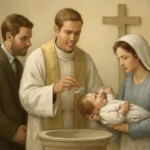
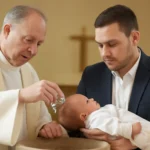
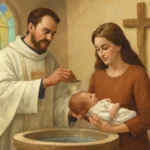
In these communities, the standard triune formula is used by a priest or deacon when performing a sacramental baptism. The rite is typically accompanied by immersion or pouring of water (depending on regional custom and the availability of a baptismal font). The catechetical emphasis—that the baptized are incorporated into the life of the Triune God and the Church—runs through the entire rite, from the profession of faith to the confirmation that often follows in Catholic practice.
Eastern Orthodox and Oriental Orthodox Traditions
In many Orthodox rites, baptism is administered by triple immersion in a single ceremony, typically accompanied by chrismation (unction with holy oil) and a continuation into catechesis and Eucharistic life. The triune formula is spoken by the celebrant at the moment of baptism, reinforcing the belief that the believer is entering into the life of the Trinity and becoming a member of Christ’s Body on earth.
Anglican, Lutheran, and other Protestant liturgies commonly preserve the triune formula and may adapt the wording to contemporary English while retaining the doctrinal core. Some Anglican contexts emphasize baptismal regeneration or the covenantal aspect of admission to the Church, depending on theological orientation, but the invocational formula remains a shared marker of Trinitarian faith.
Variations in Vernacular and Creedal Contexts
In many contexts, the baptismal rite includes an accompanying profession of faith, catechesis, and a naming ceremony. The exact ordering—whether the baptism precedes or follows the public declaration of faith, how sponsors participate, and how candidates accompany the ritual with confirmation or first communion—varies by tradition. Nevertheless, the triune invocation remains central to the rite.
Historical Development and Practices
The practice of baptism evolved from its New Testament origins into a more standardized liturgical act across diverse Christian communities. In the earliest centuries, baptism often featured immersion in water as a sign of dying and rising with Christ, paralleling the language of Romans 6 and Colossians 2–3. The ecumenical councils and local synods helped shape a common understanding of baptism as a sacramental entry into the Church, in which the Trinity was named as the divine actor who welcomes the believer into the life of God.
As the church spread geographically, local cultures and languages influenced how the rite was celebrated, though the essential triune invocation endured. In some regions, pouring water over the candidate (affusion) became standard due to doctrinal preferences, practical considerations, or liturgical reforms that sought to accommodate infants and large congregations. In others, immersion retained its symbolic power and fidelity to ancient practice. The result is a spectrum of baptismal rites that share a common doctrinal nucleus: baptism into the Father, the Son, and the Holy Spirit.
The Didache’s prominence in early Christian education helps explain why the triune formula is anchored in the earliest liturgical memory of the church. Over time, hymnography, creedal confessions, and patristic literature reinforced the theology embedded in the rite. The catechetical impulse—to teach the new convert the mystery of the Trinity while incorporating them into the church—shaped how baptism remained a formative, lifelong discipline rather than a one-time event alone.
Practice and Ritual Life: Mode, Sign, and Symbol
Beyond the words spoken at the moment of baptism, other ritual elements carry symbolic significance and help to articulate the meaning of the Trinitarian formula.
Water symbolism: Water represents cleansing, rebirth, and new life in Christ. The mode of water application (immersion, pouring, or sprinkling) bears interpretative meaning and is chosen according to tradition, climate, and pastoral need.
Oil and chrismation (in many traditions): The anointing with oil often accompanies baptism, signifying being sealed with the Holy Spirit and set apart for service in the church, a practice common in Eastern traditions.
Sponsors and baptismal faith: Godparents or sponsors may publicly affirm the candidate’s faith, reinforcing the communal dimension of baptism and the responsibility of the church to nurture new members in the faith.
Post-baptismal rites: In many churches, baptism is immediately followed by confirmation or first Eucharist, sealing the new life in Christ within the ongoing life of the church community.
In liturgical practice, the moment of baptism is celebrated with distinctive musical and ceremonial patterns, but the triune invocation remains the focal point. The exact sequence— profession of faith, renunciation of sin, reaffirmation of the baptismal covenant, the actual act with water, and the invocation of the Trinity—varies by tradition but consistently centers the believer’s entry into the divine life through the triune God.
Contemporary Practice and Ecumenical Considerations
In recent decades, discussions about baptism across Christian denominations have emphasized ecumenical sensitivity and a shared commitment to baptism as a fundamental Christian sacrament. While the wording and surrounding rites may differ, many churches recognize baptism administered in a valid form by another tradition, leading to respectful practices regarding reception, confirmation, or reaffirmation as appropriate in each community.
Ecumenical recognition: Denominations often navigate how to respect differing baptismal formulas while preserving a shared sense of baptism as entry into Christ’s Body. Some traditions practice “reception” or “confirmation” to acknowledge a baptism performed elsewhere in a way consistent with their faith and practice.
Theology of infants and believers: Debates about infant baptism versus believer’s baptism influence how the triune formula is framed in the rite. In infant baptism, sponsors and the faith of the community are emphasized; in believer’s baptism, personal confession of faith is foregrounded. Both approaches still retain the triune invocation as the theological heartbeat of the rite.
In global Christianity, diverse cultural contexts influence how the formula is pronounced, how the ceremony is staged, and how long the priest or minister spends with the candidate. Yet, the core conviction endures: through water and the invocation of the Father, Son, and Spirit, a person is incorporated into the life of God and into the worshiping community.
As with many doctrinal subjects, misunderstandings can arise around the baptismal formula. Here are a few clarifications that help illuminate the topic without diluting its meaning:
All three persons of the Trinity are invoked in the standard form, underscoring the unity of God and the distinct roles of Father, Son, and Spirit in the work of salvation.
The words do not create the grace by themselves; rather, the rite communicates the church’s faith that God, who has acted in history through the Triune God, grants grace in baptism.
Occasional variation does not imply a rejection of the Trinity—differences in wording often reflect linguistic, cultural, and liturgical preferences rather than doctrinal denial of the Trinity.
Historical sources show variety—the early church sometimes used different forms in baptism; over time, a consensus formed around the threefold invocation because of its catechetical and liturgical clarity.
Global Perspectives: A Comparative Look
Understanding how different Christian traditions articulate and enact the baptismal formula reveals the richness of Christian liturgy. The following snapshot highlights some regional and ecclesial emphases while reaffirming shared convictions about baptism as Trinitarian initiation:
Western Latin Rite (Roman Catholic, some Anglican communities): ritual precision in the Latin and vernacular forms; immersion or affusion depending on context; emphasis on baptism as entry into the Church and the life of grace within the Church’s sacramental economy.
Eastern and Oriental Churches (Byzantine, Coptic, Syriac, Armenian): often triple immersion as part of baptism, followed by chrismation and Eucharistic initiation; emphasis on the fullness of the grace of God poured out in the life of the believer and the community.
Protestant families (Lutheran, Reformed, evangelical traditions): breadth in liturgical form, with the triune name at baptism forming a common confessional baseline; diverse modalities of reception and confirmation in various denominational structures.
Ecumenical partnerships: increasing dialogue about common baptismal recognition, mutual acceptance of baptisms performed in other traditions, and shared commitments to mission and local church life.
Key Takeaways: The Significance of the Trinitarian Formula
Across centuries and cultures, the Trinitarian baptism formula has served multiple, reinforcing purposes:
It proclaims a foundational Christian confession: belief in the one God in three persons who act in salvation history as Father, Son, and Spirit.
It marks the conversion of a person into the life of a worshiping community that bears witness to the gospel in word and deed.
It grounds baptism in a robust ecclesial identity that connects the recipient with the universal church, past and present, across locales and languages.
It organizes the rite into a narrative of creation, redemption, and sanctification—invoking the Father’s creation, the Son’s redemption, and the Spirit’s renewal in the life of the believer.
The practice of naming the Trinity in baptism is more than a formula; it is a catechetical instrument, a liturgical signal, and a theological declaration that the Christian life is lived within the triune life of God. Whether celebrated in a grand cathedral, a parish font, or a small chapel in a remote community, the triune invocation remains a poignant reminder of baptism’s deepest claims: that God, as Father, Son, and Spirit, invites and accompanies his people into a new existence—together.
In sum, the Trinitarian baptism formula—whether expressed in English, Latin, Greek, or other tongues—represents a shared conviction about who God is, how God acts, and what it means to begin life in Christ within the Church. Variations in wording or ceremony reflect the church’s long history of encountering diverse cultures and languages while preserving a consistent core: baptism is performed in the name of the Father, and of the Son, and of the Holy Spirit, and the believer is welcomed into the life of the Triune God and the community of faith.







Leave a Reply