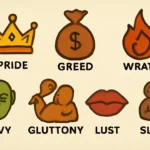
7 Deadly Sins in the Bible: Origins, Meanings, and Biblical References
The phrase “seven deadly sins” is a traditional labeling used in Christian moral theology to describe
set of vices that are considered especially corrosive to the soul and likely to lead to further sinfulness.
It is important to note that the Bible does not present a single, formal list named as such.
The development of the list is a product of early Christian reflection, church teaching, and literary culture
that sought to identify root sins that generate many others. Over time, the formulation came to be known as the seven cardinal sins or the seven capital sins, and this framework has been
influential in theology, art, and popular culture.
In this article, we explore the origins of the concept, unpack the meanings of each sin,
and point to biblical references that informed the traditional understanding. You will encounter
variations in terminology—such as pride sometimes called vainglory or hubris, and greed often rendered avarice or covetousness—to reflect the rich linguistic history of how these ideas
were discussed in different eras and languages.
Origins and Terminology: How the Concept Emerged
The origin story of the seven deadly sins lies not in a single Bible verse but in the ongoing effort of
early Christian thinkers to catalog the vices that most distort human life before God. A foundational influence comes from
the Egyptian monk Evagrius Ponticus (late 4th century), who identified a set of chief temptations
that he called «evil thoughts» or «logismoi.» His list was originally longer and included several categories, including
gluttony, lust, avarice, sadness (acedia), anger, vainglory, and others. Over time, as Christian moral theology developed,
theologians began to group these under a smaller set.
A major shaping moment occurred with Pope Gregory I (late 6th century), who reformulated the list into
seven clearly defined vices and gave them a more consolidated structure. Gregory’s effort helped standardize the
terminology across Latin Christianity. Later, the medieval poet Dante Alighieri popularized the
arrangement in his Divine Comedy, in which the seven sins are depicted as circles or ravaging forces that trap the soul.
This literary treatment reinforced the moral imagination of generations to come.
In Catholic theology, these vices came to be known as capital sins or cardinal sins, a phrase
that signals their role as “hands” from which other sins spring. The idea is that by rooting out these root impulses,
a person could cultivate virtue in many areas of life. It is worth noting that some Protestant traditions emphasize the
absence of a formal biblical list of seven, while still recognizing the biblical patterns that correspond to the
themes of pride, greed, lust, etc.
The language used to describe the sins has varied in translation and scholarship. You will see terminological variations such as pride (also called vainglory or hubris), greed (often avarice or covetousness), and sloth (sometimes linked to acedia in older texts).
These terms illuminate both the moral psychology and the spiritual posture the tradition seeks to address.
In modern scholarship and popular discussion, you will encounter phrases such as “the seven deadly sins in Christian tradition” or “seven deadly sins in moral theology”,
which acknowledge that the list is a canonical framework rather than a direct biblical catalog. The sections that follow
examine each sin on its own terms—its meanings, how it can be recognized in behavior, and the biblical materials that scholars commonly connect to the concept.
The Seven Sins in Detail: Meanings, Variations, and Biblical Echoes
Pride (also known as Vainglory or Hubris)
Pride is often described as an excessive self-regard or a posture that treats the self as
ultimate authority rather than God. In classical Christian thought, pride is considered the root from which other
vices take their first breath, because it places the self in the position rightly due to God alone.
The biblical witness presents pride in both positive and negative lights, but the moral emphasis in the traditions
is on humility as the path to genuine wisdom and obedience.
Key biblical references:
Proverbs 16:18 — «Pride goes before destruction, and a haughty spirit before a fall.»
Isaiah 14:12-15 — the lament of the king of Babylon who says, “I will ascend to the heavens; I will raise my throne above
the stars of God” (a cautionary portrait of exaltation apart from God).
Luke 18:9-14 — the parable of the Pharisee and the tax collector emphasizes humility before God, warning against self-righteous pride.
James 4:6 — “God opposes the proud but gives grace to the humble.”
Meanings in daily life: Pride appears when people insist on their own agenda, demand recognition, or assume moral superiority
over others. In biblical terms, this often means failing to acknowledge God’s sovereignty, or treating human achievement as sole cause.
Greed (also called Avarice or Covetousness)
Greed, or an insatiable desire to accumulate wealth or possessions, is treated as a form of idolatry when
wealth becomes the ultimate object of trust, security, or identity. The biblical authors warn that greed distorts ethics,
community life, and the proper ordering of desires before God.
Key biblical references:
Luke 12:15 — “Take care, and be on your guard against all covetousness, for one’s life does not consist in the abundance of his possessions.”
Colossians 3:5 — “Put to death therefore what is earthly in you: sexual immorality, impurity, evil desires, and covetousness.”
Exodus 20:17 — “You shall not covet your neighbor’s house… or anything that is your neighbor’s.”
1 Timothy 6:9-10 — “But those who desire to be rich fall into temptation, into a trap, and many foolish and harmful desires.”
Meanings in practice: Covetousness challenges appreciation for what one has, fuels envy, and can lead to exploitation or deceit.
The biblical perspective stresses contentment and trust in God’s provision rather than a perpetual chase for more.
Wrath (often understood as anger with harmful outcomes)
Wrath in the biblical sense includes righteous anger toward injustice, but it also refers to uncontrolled anger
that harms others and severs peace. The ethical teaching is not to eradicate anger completely, but to channel it toward God’s purposes
while avoiding vindictive, personal retaliation.
Key biblical references:
James 1:19-20 — “Let every person be quick to hear, slow to speak, slow to anger, for the anger of man does not produce the righteousness of God.”
Ephesians 4:31 — “Let all bitterness and wrath and anger and clamor and slander be put away from you.”
Romans 12:19 — “Beloved, never avenge yourselves, but leave room for God’s wrath.”
Meanings in contemporary life: Unchecked wrath can destroy relationships, communities, and personal integrity. The scriptural call is to discipline the tongue, practice forgiveness, and seek reconciliation.
Envy (also called jealousy in some translations)
Envy is an interior vice that resents others’ good fortune and desires what belongs to another.
It often accompanies a lack of generosity and can fuel conflict, slander, or social discord.
Key biblical references:
Proverbs 14:30 — “A tranquil heart gives life to the body, but envy makes the bones rot.”
James 3:16 — “For where jealousy and selfish ambition exist, there will be disorder and every vile practice.”
Psalm 37:1-2 — “Fret not yourself because of evil doers; be not envious of wrongdoers.”
Meanings in life: Envy disrupts solidarity, erodes trust, and blinds people to their own gifts. The antidote is often grateful contentment and benevolence toward others.
Lust (often described as uncontrolled sexual desire)
Lust refers to sexual desire that exceeds the boundaries appropriate to one’s commitments and the moral order.
In the biblical ethic, lust is not only about sex but about how desire misdirects love and the good gifts of God.
Key biblical references:
Matthew 5:27-28 — “You have heard that it was said, ‘You shall not commit adultery,’ but I say to you,
everyone who looks at a woman with lust has already committed adultery with her in his heart.”
1 Thessalonians 4:3-5 — “This is the will of God, your sanctification: that you abstain from sexual immorality; that each of you
control his own body in a way that is holy and honorable.”
Colossians 3:5 — “Put to death therefore what is earthly in you: sexual immorality, impurity, evil desires, and covetousness.”
Meanings in life: Lust is not merely tasting temptation but allowing obsession to govern decisions, speech, and relationships.
The biblical strategy emphasizes guarding the heart, renewing the mind, and honoring the dignity of others as images of God.
Gluttony (excessive appetite, especially for food)
Gluttony is commonly understood as an overindulgence that puts appetite above conscience, health, and stewardship.
In biblical perspective, it is closely linked to self-control and the misalignment of physical desires with spiritual priorities.
Key biblical references:
Proverbs 23:20-21 — “Be not among winebibbers, among gluttonous eaters of meat; for the drunkard and the glutton will come to poverty,
and slumber will clothe them with rags.”
1 Timothy 6:8 — “But if we have food and clothing, with these we will be content.”
1 Corinthians 9:27 (context of self-discipline) — “But I discipline my body and keep it under control.”
Meanings in daily life: Gluttony challenges temperance in eating, drinking, and consumption at large.
The biblical voice invites gratitude for provision, moderation in appetite, and a spirit of stewardship over one’s body and resources.
Sloth (acedia, spiritual indifference or neglect)
Sloth in the moral sense is not merely laziness about physical tasks; it is spiritual indifference—an
erosion of diligence in love of God and neighbor. The biblical tradition links sloth with neglect of duties, fear, and
the failure to use God-given gifts for the common good.
Key biblical references:
2 Thessalonians 3:10 — “If anyone is not willing to work, let him not eat.”
Proverbs 19:15 — “Laziness casts into a deep sleep, and an idle person will suffer hunger.”
Proverbs 21:25 — “The desire of the sluggard kills him; for his hands refuse to labor.”
Meanings in life: Sloth warns against spiritual inertia and the failure to cultivate virtue. The remedy is active faith, disciplined discipline, and a willingness to engage in works of love and service.
Across these seven vices, you will notice a common thread: each vice distorts proper loves—that is, the correct
ordering of desires toward God, neighbor, and the good life. The biblical text repeatedly calls believers to a
life of humility, contentment, self-control, and trust in God.
Biblical Foundations: How the Bible Informs the Concept
While the Bible does not name a single, canonical list of the seven deadly sins, it does present moral patterns
that theologians and teachers have linked to these vices. The biblical vocabulary that contributes to the concept
includes words like pride, covetousness, anger, lust, gluttony,
and sloth in varied contexts. The synthesis of these motifs into a unified list emerged through
theological reflection on human motivation, sin, and the gospel’s call to transformation.
Some key themes to keep in view:
Root causes and consequences: The sins are often treated as root impulses that generate other sins such as deceit, violence, injustice, or neglect of the vulnerable.
Contrast with virtue: Virtues such as humility, generosity, patience, chastity, temperance, diligence, and contentment are framed as the proper responses to temptation.
Pastoral aim: The list serves as a practical tool for moral formation, spiritual discernment, and communal accountability rather than a rigid checklist.
The traditional label “seven deadly sins” is thus best understood as a theological and devotional
instrument—one that helps believers recognize patterns of desire that pull away from love of God and neighbor.
Readers may encounter these terms in different translations and theological works, and some modern writers
emphasize how these sins interact with social, economic, and cultural contexts.
Variations on the Theme: Language, History, and Contemporary Usage
In addition to the classic list, scholars and teachers sometimes speak of related concepts such as “the capital sins,”“the cardinal vices,” or “mortal sins” in Catholic theological language.
Each term carries nuances about the severity, pervasiveness, and potential consequences of the sin in question.
Some writers highlight different emphases or reorder the list according to pastoral concern—for instance,
some Christian communities may stress greed or lust more prominently in discussions of
social justice or sexual ethics, while others foreground pride as the root from which other temptations flow.
In popular culture, the phrase “seven deadly sins” has taken on a broader life as a literary and artistic motif.
Yet in biblical study, the emphasis remains on how these vices reveal the condition of the heart and how
the gospel calls for repentance, renewal, and the path of virtue.
Practical Reflections: How to Use this Framework
For readers seeking a thoughtful application of these ideas, consider the following practical approaches:
Self-examination: Use the seven vices as a diagnostic framework to reflect on areas of life where
desire is misdirected. Journaling, confession, and spiritual direction can be helpful in this process.
Community rhythms: In a faith community, accountability structures, sermons, and ministries can address
how each vice manifests in relationships, workplaces, and social life.
Virtue formation: Pair each vice with corresponding virtues (humility–humility and service, generosity, patience, chastity, temperance, diligence, contentment)
and practice concrete spiritual disciplines to reinforce healthy patterns.
It is also valuable to remember that the biblical call is not merely to suppress vice but to
fulfill the higher command to love God and neighbor. The apostolic exhortation to live by the Spirit
(Galatians 5:16-26) offers a framework for walking in the power of grace, cultivating virtues that overflow into
compassion, justice, and peace.
Conclusion: The Seven Deadly Sins as a Map for Moral and Spiritual Growth
The tradition of the seven deadly sins remains a historically rich and pastorally useful tool for
understanding how desire shapes conduct, how humility anchors moral life, and how
communities can cultivate grace-informed transformation.
Whether you encounter these ideas as the seven cardinal sins, capital vices, or simply as a
lens for examining human behavior, the core message is persistent: desire rightly ordered toward God and neighbor
sustains life in harmony with God’s purposes. When any of these vices take root, relationships fracture, communities suffer,
and the image of God in human beings is dimmed. When virtue—rooted in faith, hope, and love—takes hold, lives are renewed, and
communities are shaped by integrity, generosity, and mercy.
If you wish to explore further, look for sermons or commentaries that trace how each vice appears in scripture and in the
lived experiences of people across cultures. You may find it helpful to cross-reference the verses listed under each sin
with translations you trust, as wording can vary. The conversation about these vices is ongoing, and the practical task
of applying biblical wisdom to contemporary life remains as relevant today as ever.

 Por Laura Jara