7 Churches of Asia: Guide to the Seven Ancient Cities invites readers on a journey through the classical landscapes of western Asia Minor. In Christian tradition, this phrase refers to the seven early Christian communities described in the final book of the New Testament, the Book of Revelation. In scholarly terms, these sites are located along a historic route in Asia Minor, a region that corresponds roughly to modern-day Turkey. Known as the seven churches of Asia in Revelation 2–3, or as the seven ecclesiastical cities of Asia Minor, they form a traveling exhibit of endurance, reform, and social change in the late antique world. This article—often framed as a guide to the Seven Ancient Cities—offers a detailed exploration of each site, its historical backdrop, its role in the letters to the congregations, and what visitors can still see today. In this sprawling panorama, you will encounter archaeology, sacred history, and the enduring human impulse to seek meaning in city streets and sanctuaries alike.
In the pages of a single biblical text, the Seven Churches of Asia become a map of early Christian life under Roman rule. These seven Christian communities—each addressed with a prophetic message—offer a compact study in faith, peril, and resilience. The term Asia Minor here is not a religious abstraction; it designates actual urban centers whose ruins preserve a layered history: Hellenistic architecture, Roman engineering, and Christian worship shaped by centuries of change. While the churches are not identical in status or ambition, together they illustrate several recurring motifs: the tension between zeal and compromise, the call to perseverance under pressure, and the imperative to align practice with sacred teaching.
For readers and travelers alike, this overview provides essential context for what follows. You will encounter these themes in each city’s archaeological remains, in the epistolary tone of Revelation, and in the modern landscapes where old inscriptions, ruined temples, and new churches sit side by side. It is also useful to note a few cross-cutting topics that recur across the seven churches: persecution, heresy and Nicolaitian concerns, liturgical memory, and the enduring question of spiritual fervor versus complacency.
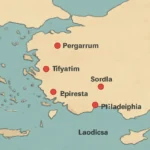
Geographic arc: coastal beginnings at Ephesus move inland through Smyrna, Pergamon, Thyatira, Sardis, Philadelphia, and Laodicea.
Literary frame: Revelation 2–3 contains the seven messages, each addressed to a named city with unique characteristics.
Historical frame: while the texts reflect later Christian communities, the sites themselves reveal earlier layers of urban life in the Roman world.
Ephesus: The First Church in Asia
Historical background
Ephesus is among the most storied cities of Asia Minor, boasting one of the ancient world’s largest harbors and a temple that drew pilgrims from across the Mediterranean—the Temple of Artemis (the Artemision). In the New Testament narrative, the church in Ephesus stands as a prominent example of early Christian preaching and institutional organization. The city’s long-standing cultural life and its port economy helped the early Christians in Ephesus to reach a diverse audience, from Greek-speaking merchants to local residents. Within the biblical letters, the church in Ephesus is praised for doctrinal soundness and perseverance but cautioned for losing its first love.
In Revelation: significance within the seven churches
The message to the church of Ephesus appears in Revelation 2:1–7. The text commends diligence and discernment while warning that zeal must be paired with heartfelt devotion. The refrain about returning to your first love has resonated in Christian memory as a call to maintain passionate fidelity while engaging with a complex urban world. This section of the Apocalypse uses Ephesus as a model of upright conduct that risks becoming hollow unless love for the divine remains central.
What remains today and visitor notes
Today’s visitors encounter a landscape where antiquity and suburbia blend. The ruins at Ephesus feature one of the best-preserved classical theaters in the world, the Great Theatre, plus the Library of Celsus and other monumental phases of urban life. Nearby, the sacred precinct of the Temple of Artemis (Artemision) once dominated the skyline, though little remains of the temple itself. The nearby village of Selçuk houses the House of the Virgin Mary, a later Christian pilgrimage site, and other attractions such as the Basilica of Saint John that reveal the layered Christian memory of the area. A practical note for travelers: combine a visit to the ancient ruins with a walk through the modern market town of Selçuk to taste local flavors and reflect on how the ancient port life shaped early Christian communities.
Key sites: Library of Celsus, Great Theatre, Ayasuluk Fortress nearby, Basilica of Saint John, Meryem Ana House (House of the Virgin Mary).
Geography: Coastal plain of Ionia, inland from Izmir, with the ancient harbour at Selçuk.
Travel tip: For a richer experience, allocate an extra day to walk the hillside routes that overlook the ruins and to explore the nearby village markets.
Smyrna, today known as Izmir in modern Turkey, has a millennia-spanning urban history. It was a major Hellenistic and Roman city, endowed with civic monuments, a sophisticated harbor economy, and a resilient sense of identity. The seven churches of Asia include Smyrna as a community that endured persecution with steadfastness, earning commendation in the Revelation narrative for its faithfulness under pressure.
In Revelation: a model of perseverance
The letter to the church in Smyrna (Revelation 2:8–11) does not rebuke them for fault but encourages endurance in the face of suffering and poverty. The author asserts that those who persevere will receive a reward and will not be harmed by the second death. This message positions Smyrna as a case study in spiritual resilience under imperial pressure, a theme that resonates with scholars studying early Christian minorities within the Roman Empire.
What remains today and visitor notes
In Izmir, archaeological traces of ancient Smyrna sit amid a bustling modern city. Visitors can view remnants of Roman-era public buildings, streets, and the coastline that once sustained a busy harbor trade. While not as concentrated as Ephesus, Smyrna’s ruins still offer a tangible sense of pretend prosperity, imperial architecture, and the long arc of urban memory. For travelers, a day in Izmir can be enriched by visiting the ancient agora district, the site of early Christian worship, and the hilltop panoramas that reveal how the city met the sea.
Key sites: Roman agora remains, ancient harbor walls, and the Polycarp’s tomb tradition in Izmir area.
Nature and urban life: A blend of coastal beauty and dense modern neighborhoods; a reminder that ancient churches often coexisted with bustling trade.
Travel tip: Combine Smyrna’s ancient traces with a seaside meal in Alsancak or Kordy; the day ends best near the waterfront promenade.
Pergamon: The Third Church of Asia
Historical background
Pergamon—known as Bergama in contemporary Turkey—was a major Hellenistic and later Roman center famed for its acropolis, library, and medical temple complex dedicated to Asclepius. It was among the great cultural capitals of its era, rivaling Alexandria in its parchment tradition and library activity. In the early Christian period, Pergamon was a site of scholastic exchange and urban intensity that shaped the life of local congregations and their neighbors.
In Revelation: the city with a strong stance
The Revelation letters address the church in Pergamon (Revelation 2:12–17) with a note about holding fast to faith in a challenging environment, where the city’s imperial cult and philosophical schools posed temptations. The passage also mentions the defeat of Nicolaitans and the demand to repent. This makes Pergamon a symbolic theater for the clash between political power and spiritual integrity in the late antique world.
What remains today and visitor notes
Modern visitors to Bergama encounter an extraordinary combination of ancient basements and elevated sanctuaries. The Acropolis remains a staggering feature, with cliff-speared vantage points overlooking the plains. The Altar of Zeus and the Asklepieion—the healing temple dedicated to Asclepius—are among the city’s most celebrated relics. The site’s theater and the lower-lying ruins reveal the grid of Pergamon’s urban plan, illustrating why it was a hub of learning and culture in antiquity. For the curious traveler, a visit here is a pilgrimage into the ambiance of a city that educated minds and offered spiritual care through healing and philosophy alike.
Key sites: Acropolis, Altar of Zeus, Asclepieion (Asklepios sanctuary), ancient library remains (historic connections to scribal culture).
Culture: A center of learning, philosophy, and medical healing; a strong example of late Hellenistic urban sophistication.
Travel tip: The ascent to the Acropolis is steep but rewarding; allocate several hours to explore the terrace views and the surrounding museum exhibits.
Thyatira: The Fourth Church of Asia
Historical background
Thyatira—present-day near Akhisar in Manisa Province—was notable for its industrial character in antiquity, including guilds and crafts tied to textiles and dyeing. This site, though less famous than Ephesus or Pergamon, held a crucial place in the interconnected network of Asia Minor towns that combined commerce and religious life. The church at Thyatira is remembered in Revelation for its mixed report: positive commendation for works and love, but corrective rebuke for permitting Jezebel-like influences that promoted spiritual compromise.
In Revelation: the Jezebel problem
In Revelation 2:18–29, the church in Thyatira is commended for faithfulness but warned about the dangers of tolerating false teaching and moral laxity. The figure of Jezebel—a symbolic name for a corrupting influence—serves as a warning that genuine faith must translate into ethical living and doctrinal clarity. Thyatira’s letter illustrates how a community can maintain outward activity while facing internal tensions that threaten its witness.
Archaeological remains at the Thyatira site show city walls, water features, and roman-era layouts that speak to a thriving urban economy. The nearby modern towns provide a gateway to the landscape of western Anatolia, where you can reflect on how guild associations and religious life intersected in antiquity. For the visitor, Thyatira offers a quieter, contemplative experience compared to the more famous sites; it rewards careful study of the layered remains and a sense of how early Christian communities navigated social affiliations in a busy market economy.
Key features: Walls, baths, and the remains of small civic buildings; evidence of industrial activity linked to textiles and dyes.
Historical note: A city that thrived on trade networks and produced a robust urban culture within Asia Minor.
Travel tip: Combine Thyatira with a stop at nearby Akhisar’s local markets to experience regional crafts and cuisine.
Sardis: The Fifth Church of Asia
Historical background
Sardis stands as a symbol of ancient wealth and political power in Asia Minor. It was the capital of the ancient kingdom of Lydia, renowned for its coinage and the loom of wealth that made it a center of commerce. The city’s layered history includes Persian, Hellenistic, and Roman phases, making it an ideal backdrop for examining the challenges faced by early Christian communities within a bustling metropolitan economy.
In Revelation: the danger of complacency
The church in Sardis is addressed in Revelation 3:1–6, where the critique is stark: the city’s church appears to be alive in name but is spiritually dead. The passage urges revival, vigilance, and the moral imperative to live out authentic faith. The Sardian letters thus function as a powerful reminder that institutional success without spiritual vitality can erode the core message of the gospel.
What remains today and visitor notes
The ruins at Sardis include an impressive Acropolis with the remains of the ancient cultic complexes, an extensive gymnasium, and the famous Artemis temple precinct remains associated with the city’s earlier religious life. The site also preserves the colossal Synagogue and tomb fields that reveal its early Roman and late antique phases. For travelers, Sardis offers a sense of the transition from a currency-driven ancient metropolis to a Christian community negotiating new loyalties and identities in a changing empire.
Key sites: Sardis Acropolis, Gymnasium, Temple precincts, tombs and synagogues.
Economic history: A major center for coinage and commerce in Lydia; wealth shaped social and religious life.
Travel tip: Given the site’s scale, plan a half- to full-day visit and bring water, hats, and sun protection for outdoor exploration.
Historical background
Philadelphia—today Alaşehir in western Anatolia—was founded as a frontier city with strategic importance and enduring cultural vibrancy. The name itself, meaning “brotherly love,” has connotations of hospitality and civic unity, reflecting how the ancient city positioned itself socially and politically within the broader mosaic of Asia Minor.
In Revelation: a faithful city with open doors
The church in Philadelphia receives commendation for its perseverance and minimal faults (Revelation 3:7–13). The letter emphasizes the city’s role as a place with “little strength” that nevertheless kept Christ’s word, and it promises protection from trials and a guaranteed space in the divine plan. Philadelphia’s message underscores the idea that spiritual resilience can emerge in places that are small in numbers but large in faithfulness.
What remains today and visitor notes
In the modern town of Alaşehir, the ancient Philadelphia site is a quiet corner of memory with a few preserved architectural traces and interpretive markers. The surrounding countryside bears testimony to a landscape of agricultural and trade networks that sustained the city across centuries. Visitors often pair Philadelphia with nearby archeological digs and rural markets, gaining a sense of how frontier cities in Asia Minor balanced security with opportunity while hosting diverse communities.
Key sites: City walls, ancient gates, and traces of civic infrastructure; ritual spaces tied to early Christian worship.
Local life: A practical example of how frontier cities integrated religious life with commercial enterprise.
Travel tip: Add a side trip to nearby agricultural towns to sample regional cheeses and olive oils common in the region’s culinary culture.
Laodicea: The Seventh Church of Asia
Historical background
Laodicea—often rendered Laodicea on the Lycus—is located near the modern town of Denizli in western Turkey. It was a wealthy urban hub renowned for banking, textile production, and medicine. The city’s location at the crossroads of major routes made it a wealthy and cosmopolitan center in antiquity, a fact that colors its portrayal in the Revelation letters as a city with abundant wealth but a spiritual posture described as “lukewarm.”
In Revelation: a warning against complacent wealth
The church in Laodicea receives Revelation 3:14–22’s famous rebuke. The text uses the metaphor of being “neither hot nor cold” to critique spiritual indifference amid material riches. The message to the Laodicean church emphasizes the need for repentance, steadfastness, and a vibrant relationship with the divine that transcends mere status or economic success. This letter has long served as a touchstone for discussions about wealth, mission, and authentic discipleship within Christian ethics.
The ruins at Laodicea include a remarkable combination of civic and religious structures: a vast theater, a colonnaded street, baths, an ancient gymnasium, and a well-preserved water supply system. The hydrological engineering visible at Laodicea demonstrates how a prosperous city managed its waters and commerce. Today’s visitors can walk along the broad streets that once hosted traders and citizens alike, and imagine the social and religious life of a thriving late Roman city. For many travelers, Laodicea makes a profound impression as a case study in how material prosperity can coexist with spiritual challenges.
Key sites: Theater, stadium, baths, water aqueducts, and the ancient streetscape.
Economy: Banking, textile industries, and medical trade; a model of urban affluence in Asia Minor.
Travel tip: Laodicea’s ruins are extensive; consider a guided tour to understand the hydraulic systems and to orient yourself within the ancient city plan.
A Route Through Asia Minor: Planning Your Visit to the Seven Churches
For travelers, a logical itinerary through the Seven Churches of Asia follows the geographical arc from Ephesus along the Aegean coast into the inland valleys and uplands of Lydia and Phrygia. A commonly recommended route begins in Ephesus and proceeds to Smyrna (Izmir), then heads inland to Pergamon (Bergama), before looping south to Thyatira (Akhisar), Sardis (near Sart), (Alaşehir), and finally Laodicea (near Denizli). The practicalities of travel—flight arrivals into Istanbul or Izmir, then car rental or driver-guided tours—mean that most visitors spend 7–14 days to experience both the ancient sites and the contemporary towns that accompany them.
Key planning considerations include the climate (hot summers; mild winters), the distances between sites (some are spread over rolling countryside), and the cultural layers that site-specific museums and local guides help illuminate. Anyone who studies the Seven Churches of Asia should be mindful of the broader historical narrative: a sequence that moves from robust Hellenistic urbanism to a Roman imperial epoch and finally to a Christianizing world that would soon be defined by monasticism and late antique church organization. A careful traveler might also include a visit to nearby Colossae or Hierapolis to gain a broader sense of the region’s ancient geography and religious topography.
Best time to visit: spring (April–June) or autumn (September–October) for comfortable weather and fewer crowds.
Practical tips: hire a local guide with expertise in archaeology and late antiquity; carry water and sun protection; wear sturdy footwear for uneven terrain.
What to bring: a map or offline navigation, a notebook for field notes, and a camera to capture the interplay of ruins and modern life.
Glossary of Key Terms and Context
: The westernmost part of the Asian continent, corresponding largely to modern Turkey; a crossroads of cultures in the ancient world.
Nicolaitans: A heretical or controversial movement mentioned in Revelation, whose exact identity is debated but used in the text to illustrate tensions within early Christian communities.
Jezebel: A symbolic figure invoked in Thyatira’s letter to denote corrupting leadership that compromises faithfulness.
Revelation: The last book of the New Testament; its letters to the seven churches form a crucial source for early Christian thought and church practice.
Conclusion: Why These Seven Cities Matter Today
The narrative of the Seven Churches of Asia transcends a mere inventory of ancient ruins. It offers a lens on how faith communities respond to pressure, how religious identity interacts with urban life, and how memory preserves the past in the present. Whether you read these as historical episodes, as allegorical addresses, or as a living itinerary for travel, the seven cities showcase the enduring human endeavor to seek guidance, stand steadfast, and cultivate communities that reflect deep values in changing environments. When you visit the sites—Ephesus, Smyrna, Pergamon, Thyatira, Sardis, Philadelphia, and Laodicea—you walk through chapters of a history that continues to inform modern discussions about faith, culture, and public life in Asia Minor and beyond.
In sum, the Seven Churches of Asia—the Seven Christian communities in Asia Minor—are not just relics of early Christianity. They are a map of moral imagination: a reminder that courage is not the absence of difficulty but the persistence to act with integrity in the face of challenge. This guide—your gateway to the ancient cities and their enduring legacies—aims to help you read the stones and streets with new attention,
and to appreciate how a small set of letters could illuminate the larger human drama of faith, endurance, and hope.

 Por Laura Jara