Millions of Christians have grappled with a question that sounds simple but is deeply debated in theology and church life: can a Christian be possessed by a demon? The phrase itself raises urgent questions about identity, spiritual reality, and the power of God. This article surveys the biblical view, distinguishes possession from related phenomena like oppression or influence, and offers practical guidance for believers who want to understand how to stand firm in Christ. While there are diverse opinions within Christianity, a careful look at Scripture helps us tease apart what is possible, what is probable, and what is prohibited in light of the gospel.
Framing the Question: can a Christian be possessed by a demon?
The phrasing itself echoes an ancient debate that stretches back to apostolic times. In everyday language, “possession” implies ownership by a demon—an entity that takes dominion over a person’s body, actions, and inner life. But the biblical record uses careful vocabulary and vivid narratives to describe spiritual realities in ways that require discernment. The question we face is not merely a linguistic one; it concerns the nature of sin, the presence of evil, and the rescue accomplished in Jesus Christ. For many readers of the Bible, the central claim is that the Holy Spirit dwells in believers, making true possession by a demon unlikely in the sense of ownership. Still, Christians can experience demonic oppression, temptation, and influence that require vigilance, prayer, and the weapons of spiritual warfare.
Key terms to distinguish: possession, oppression, and demonization
To understand the biblical view, it helps to sort terminology. The same terms can be used in different ways in different traditions, but the core ideas are often similar.
Demon possession (often the focal point of the question): a demon or demons exerting control over a person in such a way that the person’s actions, thoughts, and will are dominated by the demonic power. This is the sense in which the term is commonly used in historical descriptions of biblical miracles and exorcisms.
Demon oppression or demon influence: a more limited form of control that targets thoughts, emotions, or circumstances without the demon fully owning the person. A person might feel tormented, tempted beyond ordinary temptation, or constrained by a spiritual force, yet still held by God in Christ.
Demonization: a broader category that covers oppression, harassment, and other malign spiritual influences. Some scholars describe demonization as a spectrum rather than a binary state of possession or non-possession.
Deliverance and exorcism: practices within the church aimed at removing demonic influence or control. Deliverance is often used in Protestant circles to describe the process of bringing a person into freedom through prayer, confession, and discernment; exorcism is a term more common in Catholic and some Orthodox contexts for formal rites conducted by authorized clergy.
What the Bible actually shows: New Testament accounts of possession and authority
The Bible contains several dramatic accounts of people described as demon-possessed. These narratives are crucial because they reveal the nature of demonic power, Jesus’ authority, and the trajectory of human life under grace. It is important to note that these accounts occur in specific historical and redemptive contexts and are not simply blueprints for modern spiritual life apart from the risen Christ.
Examples of possession in the Gospels
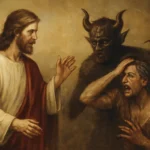
The Gerasene demoniac (Mark 5:1-20; Matt 8:28-34; Luke 8:26-39): A man “possessed by many demons” is outwardly broken, uncontrolled, and living among tombs. Jesus commands the demons to depart and sends the man into a restored condition—clothed and in his right mind—after the decisive intervention.
The boy with an unclean spirit (Mark 9:14-29; Matt 17:14-21; Luke 9:37-43): A father brings his severely troubled son to Jesus, who casts out the spirit after the boy’s convulsions and long suffering. This account highlights the limits of human power and the sufficiency of Christ’s authority.
Other first-century exorcisms throughout Mark and Luke demonstrate Jesus’ continued authority over demonic powers and the spiritual realm as a sign of the Kingdom breaking into the present age.
These accounts share some common features: a person afflicted by a powerful spirit, the confrontation with Jesus, and a public demonstration of divine power that leads to healing and restoration. They also raise the question of whether such possession is a universal pattern for all Christians or a subset of experiences tied to specific historical moments in salvation history. The biblical writers do not present demon possession as normative for every believer; rather, they present a reality of spiritual opposition and Christ’s triumph over it.
Several passages are often cited in discussions about possession for believers. These texts do not always speak directly of possession in the modern sense, but they speak to the resilience of the believer and the reality of spiritual conflict.
The indwelling Spirit and the believer’s identity
1 Corinthians 6:19-20: “Do you not know that your body is a temple of the Holy Spirit within you, whom you have from God? You are not your own.” This asserts a divine indwelling that has major implications for the question of ownership by another spirit.
Romans 8:38-39 and Romans 8:9: Nothing in all creation, including demonic forces, can separate believers from the love of God in Christ Jesus. This speaks to the security of believers and their union with Christ.
Demonic activity and spiritual warfare
Ephesians 6:10-18 (the armor of God): Believers are to stand firm against “the schemes of the devil” with truth, righteousness, the gospel of peace, faith, salvation, and the Word of God, all guarded by prayer.
1 Peter 5:8-9: “Be sober-minded; be watchful. Your adversary the devil prowls around like a roaring lion, seeking someone to devour. Resist him.” This presents ongoing spiritual conflict as a normal aspect of Christian life.
James 4:7: “Submit yourselves therefore to God. Resist the devil, and he will flee from you.” The path to victory is active obedience and reliance on God.
Is demon possession possible for a Christian?
The dominant traditional reading in much of Protestant and evangelical theology is that Christians cannot be demon-possessed in the sense of ownership because the Holy Spirit dwells in believers. The temple of the Holy Spirit cannot be simultaneously owned by a demon in a way that nullifies the believer’s new identity in Christ. However, the Bible does acknowledge that believers can be influenced, harassed, or oppressed by demonic forces, and the fight against those forces is a real, ongoing spiritual battle.
Across Christian traditions, two main approaches attempt to synthesize biblical data with lived experience. Each seeks to answer the central question while guarding the integrity of the gospel and the authority of Scripture.
1) The traditional evangelical/protestant view: no possession, but possible oppression
The believer’s position in Christ is secure through faith in Jesus. The Holy Spirit dwells in the believer, making demon possession incompatible with Christian identity. The emphasis is on:
Security in Christ (Romans 8:38-39; John 10:28-29)
Spiritual warfare as the ongoing battle against spiritual hosts of darkness (Ephesians 6:12, 2 Corinthians 10:3-5)
Protection through discipline and prayer (Luke 11:21-22; 1 Thessalonians 5:17-18)
Confession and repentance as means to remove personal sin that may open doors to oppression
In this framework, the danger is not that a demon will permanently possess a Christian, but that a Christian may experience oppression, temptation, or demonic harassment that requires discernment, prayer, and sometimes active deliverance with pastoral guidance. The emphasis is on maintaining purity, obedience, and reliance on God’s power rather than contemplating possession as a normative possibility for the followers of Christ.
2) The broader view found in some Pentecostal/charismatic and Catholic contexts: limited possession possible, but rare and context-dependent
In these streams, believers may acknowledge cases where demons attempt to exert strong influence or control, sometimes described as possession, especially in cultures or situations where spiritual oppression is intense. The key distinctions include:
Confession of Jesus as Lord remains a boundary—true Christian conversion and the new birth constitute a decisive change in spiritual allegiance.
Deliverance ministry is offered to address persistent spiritual oppression or deception that does not abolish the believer’s identity but seeks to liberate from oppressive spirits.
Pastoral caution emphasizes that power over demons belongs to Christ, and any ministering practice must be tested against Scripture, affirmed by church teaching, and carried out with consent and care for the vulnerable.
In this view, the line between possession and oppression may blur in extreme contexts, but the overarching biblical testimony remains that Jesus has ultimate authority over all powers of darkness. The practical question—“Could a Christian be demon-possessed?”—is answered differently depending on how one reads the biblical data, historical testimony, and theological framework. The safest approach for most believers is to insist on the primacy of Christ, the indwelling Spirit, and the ordinary means of grace for spiritual victory.
Whatever your doctrinal leaning, the Bible provides practical guidance for living in a world where spiritual forces oppose God’s people. The aim is not to sensationalize spiritual warfare but to equip believers to stand firm in faith.
Prioritize your relationship with God: cultivate a daily rhythm of prayer, Bible reading, and worship that keeps the heart tuned to the Spirit’s leading.
Keep a clean spiritual house: confession of sin, repentance, and obedience to Christ reduce susceptibility to deception or temptation.
Guard your associations: be mindful of influences that might invite harm or mislead spiritual discernment. This includes media, practices, or teachings that contradict Scripture.
Embrace the community of faith: confess your struggles to a trusted pastor, counselor, or mature believer. Spiritual warfare is not a solo enterprise; accountability and encouragement are vital.
Use the Word of God as sword and shield: meditate on Scripture, memorize key verses, and declare truth over fear, doubt, or deception (for example, “The Lord is my light and my salvation; whom shall I fear?” – Psalm 27).
Clothe yourself in spiritual armor: faithfully pursue righteousness, truth, faith, and salvation, and be prepared to stand against the devil’s schemes (Ephesians 6:10-18).
Seek appropriate ministry when necessary: if there are persistent signs of severe spiritual oppression, seek guidance from a church that practices sound deliverance ministry under wise oversight and with compassion for the person affected.
Many readers come to this topic with specific questions. Here are some of the most frequent concerns, with concise biblical-informed responses.
Can a Christian be possessed by a demon, really?
Based on the weight of biblical testimony, the prevailing evangelical view is that a true Christian cannot be demon-possessed in the sense of being owned by a demon. The Holy Spirit resides within the believer, making a complete ownership by a demonic power incompatible with biblical anthropology. However, demon oppression or active spiritual warfare against a believer is possible, particularly if there is vulnerability to sin, deception, or unrepented habits that invite negative spiritual dynamics.
What about mental illness or medical conditions?
It is essential to distinguish the spiritual from the physiological or psychological. Not every mental health challenge is caused by a demon. Christians should pursue medical and psychological care when appropriate, and they should not use spiritual warfare language to minimize real medical needs. At the same time, a Christian can seek spiritual support—prayer, pastoral counseling, and community—without doubting the reality of medical treatment.
How can we discern if someone is dealing with oppression or possession?
Discernment questions include:
Is there a clear profession of faith in Christ and a spiritual transformation that aligns with the gospel?
Are there persistent manifestations that contravene biblical ethics, or are these behaviors outside typical human experience?
Is there cooperative engagement with church leadership and a plan for deliverance or spiritual support that respects the person’s dignity?
What is the role of deliverance ministries in a Christian context?
Deliverance ministries aim to bring freedom from demonic oppression through scriptural teaching, prayer, and sometimes exorcistic prayer. In healthy church settings, deliverance is exercised with caution, accountability, and a clear emphasis on the person’s identity in Christ. It should never replace the ordinary means of grace—scripture, prayer, sacraments, and pastoral care—and it should never dehumanize the person by reducing them to a possession label.
From a biblical perspective, the most important posture is humility before God, worship of Christ, and a trust in the Holy Spirit’s work within the life of the believer. The core claim is that Christ’s lordship is superior to all demonic power, and Christians are called to live in a way that honors God and resists evil by the Spirit’s strength.
A synthesis for a robust Christian worldview
Affirm the security of the believer through faith in Christ and the indwelling of the Holy Spirit.
Acknowledge the reality of spiritual warfare and the reality that evil exists and seeks to mislead, tempt, or hinder the people of God.
Distinguish levels of spiritual influence from mere temptation to outright possession, recognizing that the New Testament presents a spectrum of experiences rather than a single, universal pattern for all believers.
Preserve doctrinal balance by avoiding sensationalism while remaining vigilant, compassionate, and biblically grounded.
In sum, the biblical view does not support the idea that a committed Christian can be owned by a demon in a way that negates their identity in Christ. The Holy Spirit dwells within believers, and Jesus has defeated the powers of darkness through his life, death, and resurrection. Yet the Bible also makes clear that believers are engaged in a real spiritual conflict. The possibility of oppression, deception, or harassment by demonic powers is not only plausible; it is something Christians should be prepared to resist using the Lord’s strength and the tools of spiritual warfare. The safest and most faithful approach is to ground one’s life in Christ, depend on the Spirit, submit to God in obedience, and seek wise pastoral care when there is genuine spiritual distress.
Stay rooted in Scripture: daily reading and meditation on God’s Word builds discernment and resilience against deception.
Foster a robust prayer life: regular prayer fosters intimate fellowship with God and alignment with his will.
Participate in a healthy community: weekly worship, accountability groups, and service nurture spiritual strength and humility.
Submit to wise leadership: seek guidance from pastors or mature mentors when you encounter strange spiritual experiences or distressing thoughts.
Practice discernment with care: avoid sensational claims, and prioritize Scripture, sound theology, and pastoral wisdom over rumor or unverified reports.
Discussing possession and demonization touches on deeply personal beliefs and experiences. People who have encountered intense spiritual distress deserve empathy, clarity, and care. The church’s response should be measured, compassionate, and anchored in a robust biblical anthropology that honors the dignity of every person while pointing them to the freedom found in Christ.
The short answer, grounded in Scripture, is that Christians cannot be demon-possessed in the sense of being owned by a demon because the Holy Spirit dwells in believers and binds them to Christ. What is possible, and indeed common in a fallen world, is spiritual oppression and temptation—a reality that demands vigilance, prayer, and the active pursuit of holiness. The biblical witness invites believers to stand firm in God’s strength, using the weapons of spiritual warfare, and to seek help from faithful Christian communities when faced with severe spiritual distress. By keeping Christ at the center and applying Scripture with wisdom, Christians can navigate this challenging topic with confidence and compassion.
Further reading and resources
Explore the Gospels’ exorcism narratives (Mark 5; Mark 9; Luke 8) to see how Jesus confronts demon power.
Study Ephesians 6 on the armor of God and spiritual warfare for practical guidance on standing firm in faith.
Consult theological summaries on possession, oppression, and deliverance from reputable church sources and credible commentaries.

 Por Laura Jara