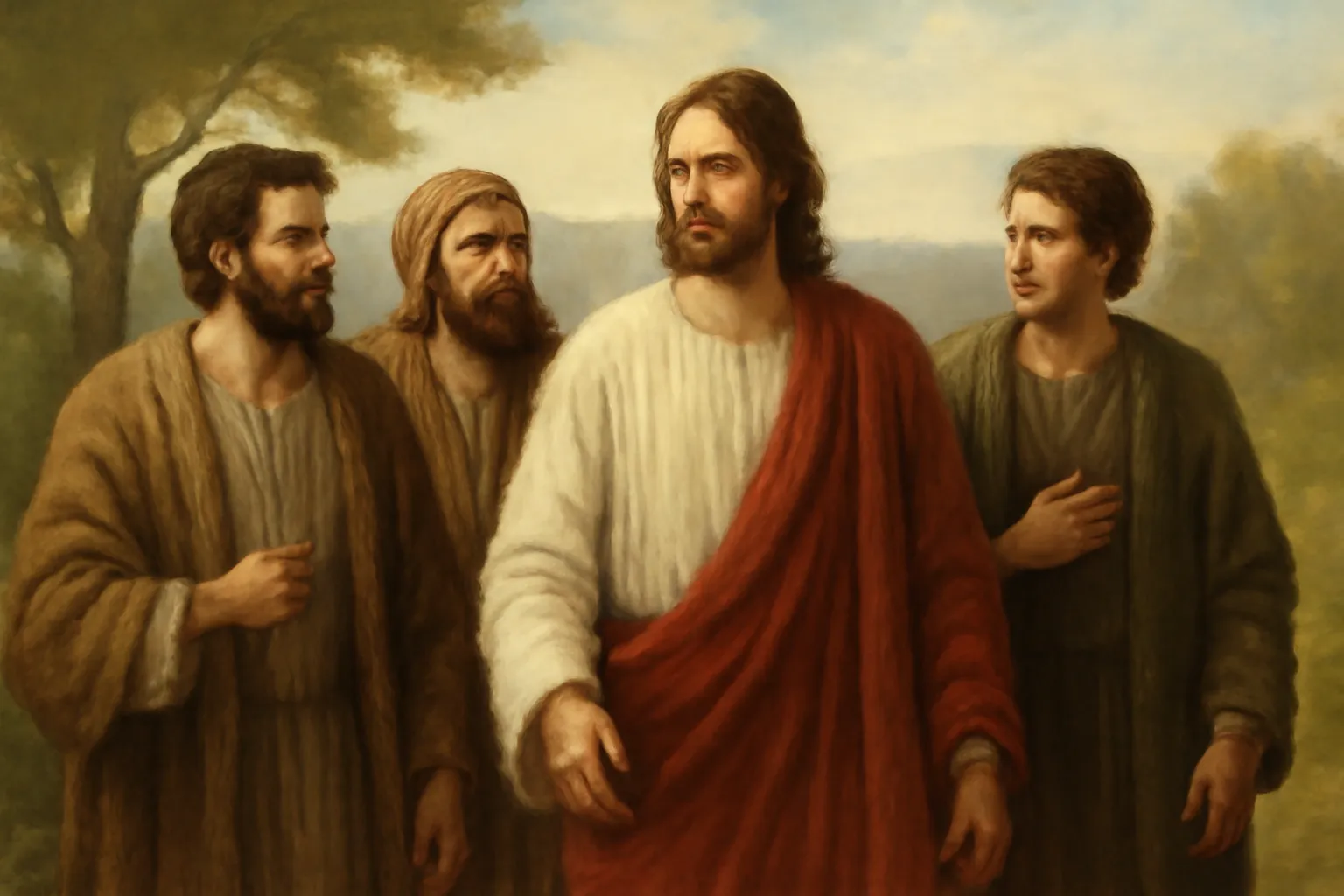
Disciples with Jesus: Who They Were and Why They Followed Him
The phrase “disciples with Jesus” conjures images of a diverse group gathered around a teacher who spoke of
a kingdom not of this world, yet deeply rooted in everyday life. The story of these followers—often called the Twelve or the apostles—is more than a list of names. It is a portrait of
people drawn from different walks of life, each called to leave a familiar path and embark on a new mission. This article
explores who the disciples of Jesus were, why they chose to follow him, and what their example teaches about
discipleship in its many forms—past and present.
Who Were the Disciples of Jesus?
The term disciple means a learner or follower. In the Christian tradition, these terms are used in
slightly different ways: some texts distinguish disciples from apostles, while others use them
more interchangeably. Broadly speaking, the core of Jesus’ early circle consisted of the Twelve Apostles, a
group summoned by Jesus to accompany him, witness his ministry, and carry forward his message after his departure.
The original Twelve Apostles
Below is a representative list of those most commonly identified as the inner circle. The names are often familiar from the
Gospel narratives, where each figure plays a distinctive role in the unfolding story of Jesus’ ministry. Some later traditions
add details about their occupations or family backgrounds, which helps to imagine the social world of the first followers.
Peter — also known as Simon Peter; a fisherman from Galilee who becomes a leading voice among the disciples.
Andrew — Peter’s brother; a fisherman who first introduces others to Jesus.
James (son of Zebedee) — part of the inner circle; brother of John; often linked with bold leadership moments.
John — James’s brother; the “beloved disciple” in many traditions; author of several New Testament writings.
Philip — a thoughtful inquirer whose conversations with Jesus illuminate questions about faith and understanding.
Bartholomew (also called Nathanael in some gospel lists) — recognized for a sincere openness to Jesus’ call.
Matthew — the tax collector who leaves his post to follow Jesus, later associated with the Gospel attributed to him.
Thomas — known for questioning and seeking clarity; often portrayed as earnest in his pursuit of truth.
James (son of Alphaeus) — sometimes called James the Less; a quieter but essential part of the group.
Simon the Zealot — identified by a background in political zeal or national loyalty, illustrating the variety within the circle.
Judas Iscariot — the one who would later betray Jesus; after his death, the circle seeks to restore the number with Matthias.
Women and other followers
While the core term disciples often centers on the Twelve, the broader circle of Jesus’ followers included many women and men who
traveled with him, supported his ministry, and carried the message after his death. In the Gospel narratives, women such as Mary Magdalene,
Joanna, Susanna, and others function as indispensable partners in the mission—often providing hospitality, resources, and witness. Their
presence highlights that discipleship with Jesus was not limited to a single sex or social class; it was a
journey open to people of varied backgrounds who shared a common commitment to the message being proclaimed.
In a broader sense, the phrase Jesus’ followers can refer to all who accepted his invitation to learn from him and to share
in his mission. This inclusive understanding helps to bridge historical categories with contemporary understandings of what it means to be a
disciple: a student, a friend, a messenger, and a witness all at once.
Why They Followed Him: Motives, Call, and Expectation
The reasons that drew people to follow Jesus were as diverse as the people themselves. The narratives emphasize
both personal encounters and broader signs that pointed to a new kind of authority and hope. Exploring these motives helps to illuminate
the dynamics of discipleship with Jesus in a way that remains relevant for readers today.
Calling and vocation
Many of the first disciples answered a direct invitation: “Follow me.” The call was immediate and demanding: leave a familiar
livelihood, alter plans, and commit to a shared path. For fishermen like Peter and Andrew, the work of mending nets and fishing became
the frame for following Jesus. In a deeper sense, the call signaled a new vocation—one that reframed ordinary work as service in the
larger project of the Messiah’s reign.
Authority, miracles, and signs
A major component of the appeal lay in Jesus’ authority and the observable signs that accompanied his ministry. The miracles—healing the sick,
feeding the hungry, calming storms, and exorcising demons—gave tangible demonstrations of a kingdom breaking into the present age. For some
followers, such signs validated a conviction that Jesus was the long-awaited Messiah; for others, they opened questions that deepened
curiosity and reflection. Either way, the sense that God’s power was at work in him drew people toward him.
Messianic expectations and spiritual mission
The term Messianic expectation has to be understood in its historical context. Many first-century Jews hoped for a political
deliverer who would liberate Israel from oppression and restore national autonomy. Jesus, however, framed his mission in terms of mercy,
service, and the renunciation of violence, guiding his followers toward a different kind of kingship. This divergence did not erase
the sense of purpose that attracted people to him; it reframed their hopes into a broader spiritual mission that extended beyond Israel
to the world.
What It Meant to Be a Disciple: Training, Friendship, and Mission
Being a disciple with Jesus was not a one-time decision but a living practice. It involved listening, learning, and
participating in a mission that would eventually extend across borders and generations. The Gospel narratives portray a dynamic that blends
instruction with action, relationship with responsibility, and personal transformation with communal growth.
Training and formation
The disciples received instruction in the rhythms of Jesus’ life: prayer, teaching, preaching, and attuning to the needs of others. They
watched him interpret Scripture, confront hypocrisy, and extend hospitality even to those society overlooked. The process of training included
practical exercises—sharing meals, traveling on long journeys, and learning to depend on God in uncertain circumstances.
Witness and proclamation
An essential dimension of discipleship with Christ was the call to witness. The Twelve were entrusted with proclaiming the
Kingdom and embodying its values through their behavior. Their witness was not only verbal but tangible: acts of mercy, justice,
and inclusion shaped the early Christian community and offered a countercultural vision of life.
The movement culminates in a pivotal moment commonly referred to as the Great Commission, where Jesus commands his
followers to go into all the world, make more disciples, and baptize them in the name of the Father, the Son, and the Holy Spirit
(paraphrasing Matthew 28:18-20). This commissioning reframes discipleship as a global mission—an invitation to participate in God’s
purposes beyond the confines of any one place or time.
Key Episodes: Notable Moments in the Journey of the Disciples
Several episodes in the gospel narratives illuminate what it meant to be a disciple with Jesus. These moments
reveal both the challenges and the growth that accompanied following him.
The first call of the fishermen
In the early chapters of Luke’s Gospel, Jesus calls Simon Peter and his brother Andrew, along with James and John, while they are
mending nets by the Sea of Galilee. The invitation is graphic and striking: “Follow me, and I will make you fish for people.”
The response is immediate, and the four leave their nets behind. This episode underscores the idea that discipleship with Jesus begins with an authoritative invitation and a decisive response.
Matthew’s call and the integration of a tax collector
The calling of Matthew, the tax collector, is a striking example of Jesus’ inclusive approach to discipleship. Accepting
Matthew into the circle challenges social boundaries and demonstrates that the path of a disciple is not limited to those with
respectable credentials. The narrative invites readers to consider how personal transformation, hospitality, and ethical change can unfold
within a community committed to a different order of values.
Peter’s confession and leadership emergence
In various scenes, Peter emerges as a spokesman and a leader among the disciples, sometimes impulsive, sometimes deeply insightful. His
confession—“You are the Christ, the Son of the living God”—marks a turning point in the portrait of faith. The other disciples witnessed
how leadership within the Jesus movement would be shaped by both humility and courage, and their shared experiences formed the backbone
of the early Christian community.
Diversity Among the Disciples: Backgrounds, Roles, and Inclusion
The circle of Jesus’ followers was not monolithic. It included people from different social standings, professions, and life experiences. This
diversity mattered because it reflected the breadth of God’s invitation and the adaptability of the mission to reach many kinds of people.
from Galilee: Their familiar world of boats, nets, and marketplaces became the theatre of a new kind of work—ministry among neighbors and strangers.
and other professionals: Their participation in the movement signaled a broadening of the circle to include those who navigated complex social systems of power and economy.
and political outsiders: The presence of figures with conflicting loyalties demonstrates that discipleship could transcend political expectations and be reshaped by a different loyalty—toward God’s reign.
Women and single-hearted supporters: The women who traveled with Jesus, provided resources, and proclaimed the resurrection illustrate the indispensable role of faithful participation beyond gender norms of the period.
This diversity also raises an important distinction: while the core group is known as the Twelve Apostles, the broader
movement included many other disciples of Jesus who contributed in crucial ways. Some scholars also point to the
presence of the Seventy (or Seventy-Two) mentioned in Luke, a broader circle sent out to preach and heal in anticipation of
Jesus’ eventual return. These figures remind readers that discipleship is a communal enterprise, not a solitary pursuit.
The Legacy and Impact: How the Disciples Shaped Early Christianity
The actions, choices, and testimonies of Jesus’ disciples had a lasting influence on the formation of early Christian
communities. Their experiences provide foundational material for understanding how faith moved from a localized movement in first-century
Judea and Galilee to a trans-regional faith that would spread across continents. The Gospel writers and the book of Acts frame the
apostles’ preaching, their experiences of persecution and grace, and their role in forming Christian communities as essential for the
transmission of the message.
Witness and proclamation in the early church
The disciples function as primary witnesses to Jesus’ life, death, and resurrection. Their firsthand accounts shaped the early church’s
understanding of who Jesus was and what he accomplished. In places where they traveled, streets and homes became sites of catechesis,
prayer, and shared meals—the everyday life of a community centered on the risen Christ.
Leadership and doctrinal development
While not all details are identical in every Gospel, the trajectory shows how leadership within the early church grew out of
discipleship: continual listening to the risen Christ, careful teaching of new converts, and a commitment to living out the values
of the Kingdom in tangible ways. The apostles’ reception of the Holy Spirit at Pentecost is presented as a turning point that enabled
the movement to extend beyond its original cultural boundaries.
Common Questions and Clarifications
To help distinguish terms and clarify common misunderstandings about this topic, consider the following points.
Disciples vs Apostles: In the biblical texts, disciples are learners and followers; the
term apostles typically refers to those commissioned to teach and lead the mission after being with Jesus.
The Twelve vs the broader circle: The Twelve form a core group, but many additional
followers contributed to the movement’s growth and witness.
Women in the movement: Women played essential roles as supporters, witnesses to the resurrection, and
participants in the mission—an important reminder that discipleship is inclusive and collaborative.
Historical context: The phrase disciples with Jesus points to a historical moment in which
rural fishermen, a tax collector, an itinerant teacher, and others formed a community around a shared conviction. Yet the
lessons of discipleship have resonated across generations and cultures.
Conclusion
The story of Disciples with Jesus is ultimately a story about invitation, transformation, and mission. It invites readers
to reflect on what it means to be a learner, a friend, and a messenger in one life. The people who followed Jesus—whether in the tightly knit
circle of the Twelve or in the larger company of his supporters—demonstrate that discipleship is not a single mode of
living but a flexible, dynamic commitment that adapts to different times, places, and opportunities. The central thread running through
their experience is the conviction that a life aligned with Jesus is a life that is opened to God’s purposes and shaped by love for God
and neighbor. For readers today, the lessons remain relevant: to listen, to learn, to step forward in faith, and to participate in a
shared project that seeks the flourishing of all people. In the end, the disciples with Jesus model a form of life
that centers humility, courage, and care—an invitation that continues to echo through communities that value faith, hope, and action.

 Por Laura Jara