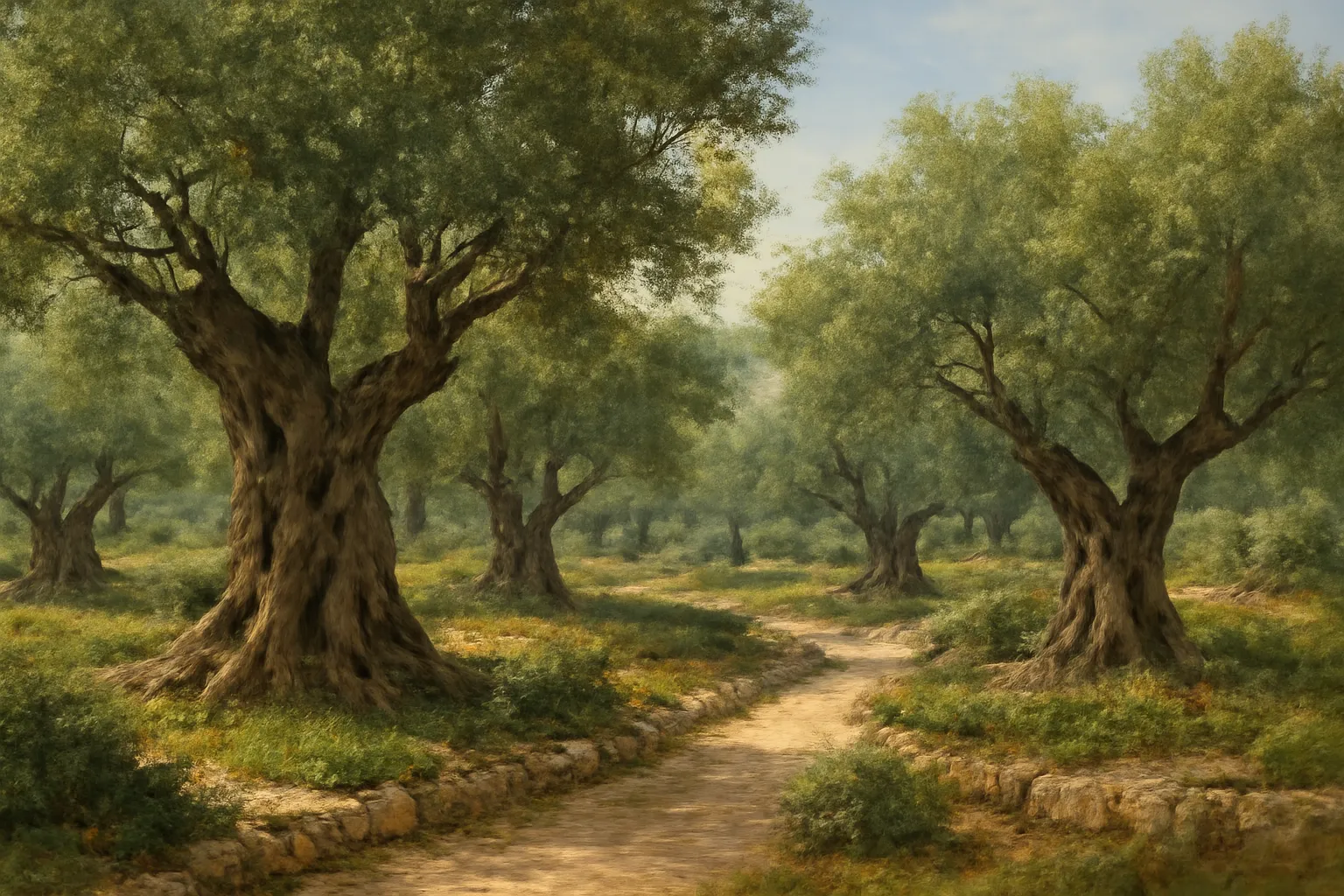
The Garden of Gethsemane is traditionally placed on the slopes of the Mount of Olives, just outside the historic walls of Jerusalem’s Old City. In biblical memory, this location is described as a sacred olive grove where Jesus and his followers spent time in quiet prayer before the events that culminated on the cross. The name Gethsemane itself carries a sense of place—an agrarian landscape where olive trees, ancient stone terraces, and a calm, almost somber atmosphere shaped the mood of the moment. The site has attracted pilgrims, scholars, and poets for centuries, making the garden a living link between geography, Scripture, and spiritual reflection.
In the geography of the gospel accounts, the oil-press landscape of this hilltop garden provided a practical context for how people in antiquity used every feature of the land. The term often interpreted as “the olive press” points to both a literal occupation—pressing oil from olives—and a symbolic image of bearing weight, pressure, and preparation. As a result, contemporary readers frequently encounter a double sense: the garden serves as a real setting in the narrative, and its name invites contemplation of inner pressure, purification, and surrender.
Meaning and Etymology of the Garden Name
The phrase Garden of Gethsemane blends linguistic layers that illuminate its significance. The word Gethsemane is commonly linked to the Hebrew Gat Shemanim, which scholars translate as “oil press”. From this etymology, readers glimpse a place whose identity is tied to olive oil production—an essential commodity in ancient economies and sacramental life. Olive oil was used for lighting lamps, anointing for ritual purification, and even medicine, so the garden’s name resonates with ideas of preparation and consecration.
A second dimension of meaning arises when we consider the garden’s narrative role in the gospels. In the Christian imagination, the garden becomes a threshold: a place where human fear and divine purpose meet. The Gethsemane narrative emphasizes obedience under pressure, the struggle to align psychological longing with a sacred plan, and the transformation that can follow surrender. This layered meaning invites readers to reflect on their own moments of decision under stress, and to see the garden as a symbolic classroom for virtue under trial.
Historical Background and the Garden’s Long Shadow
Historical memory places the olive grove of the Mount of Olives as a landscape that predates the first century and continues to be cared for into the present. Archaeological and literary sources suggest that olive trees planted along terraces could endure for long periods, and traditional accounts often associate the site with the religious life of Jerusalem across generations. While the exact dating of individual trees is difficult, many travelers have described the grove as a place where the soil carries centuries of harvests, feasts, and prayers alike.
Over the centuries, the garden’s status shifted with changing dominions, devotional orders, and pilgrimage routes. In late antiquity and the medieval period, Christian communities developed shrines around key biblical scenes, including the city’s environs near the Mount of Olives. The garden’s cultic significance grew in tandem with the church’s expanding rituals of Holy Week and commemoration. The olive trees became living witnesses to memory, and later generations erected structures that framed the garden as a space for contemplation.
Gethsemane in the Gospels: Narrative Core and Variations
The Gethsemane garden story appears in multiple canonical accounts, with some variations that illuminate different theological emphases. In the synoptic gospels, Jesus withdraws with his closest companions to pray, expressions of grave distress emerge, and a sense of imminent danger thickens the scene. The disciple group—often named as Peter, James, and John—struggles with vigilance, while Jesus prays with ardent appeal to the Father.
Jesus pervades the moment with supplication, asking that a painful cup pass, yet affirming a readiness to do the Father’s will.
The disciples repeatedly fail to stay awake, illustrating human frailty in the face of spiritual pressure.
A confidant’s betrayal is portentously near, particularly in the arrangement of the crowd that approaches with Judas.
The emotional intensity culminates in a resolve that aligns action with divine purpose, even as fear remains a palpable force.
The Gospel of John offers a differently tuned perspective, focusing more on the unfolding drama within the larger sequence of events surrounding Jesus’ arrest. The garden scene remains a hinge moment that connects Jesus’ public ministry to the events of the Passion narrative, yet the emphasis shifts toward the deeper sense of witness, obedience, and the unfolding of providential timing.
Theological Themes Emerging from the Garden Experience
The garden drama has become a touchstone for Christian reflection on several persistent themes. At its heart lies the tension between human fear and divine vocation, a tension that becomes a source of moral and spiritual insight for believers across ages.
Obedience under pressure
The most central theological claim is that obedience to a higher plan can guide a person through distress. The figure in the garden models a path from distress to surrender, showing how fidelity to purpose can be maintained even in the midst of intense personal agony.
Human vulnerability and divine compassion
The narrative does not sanitize suffering; it presents Jesus as someone who experiences fear and sorrow, enabling a theological reading that honors authentic human emotion while remaining anchored in faith. This portrayal invites readers to bring their own fears to prayer and to seek strength beyond their own resources.
Prayer as a turning point
Prayer in the olive garden becomes a model of intimate dialogue with the divine. The discipline of prayer—whether in sorrow, petition, or submission—offers a pattern for personal life, communal worship, and spiritual discernment.
Historical Worship, Pilgrimage, and the Garden’s Sacred Architecture
Across centuries, Christians have visited the Garden of Gethsemane to engage in contemplation, liturgy, and pilgrimage. The site has been the focus of several architectural phases, from early cross-cultural shrines to more modern ecclesiastical structures that enshrine the memory of the event.
From antiquity to the medieval church
Early Christians recognized the garden as a sacred place where faith could be tested and refined. Monastic communities and later church-builders sought to preserve the memory through chapels and sacred spaces, turning the site into a living catechesis about discernment, courage, and fidelity.
Modern commemorations and the Church of All Nations
In the 20th century, a number of building projects and restorations reinforced the garden’s role as a place of prayer. The Church of All Nations, also known as the Basilica of the Agony, sits adjacent to the Garden of Gethsemane and anchors the site in a modern architectural context. While the exact olive trees may not be as ancient as popular legend suggests, the church and surrounding grounds continue to host visitors seeking to connect memory with devotion.
The site often features a collection of olive trees that are carefully tended as part of the landscape. These trees, whether they are ancient or relatively younger, symbolize resilience, life, and the continuity of prayer through generations.
Olives, Rocks, and Symbolic Significance
The physical features of the garden—its trees, terraces, and the nearby rock—have taken on symbolic meanings that enrich theological interpretation. The rock in the Church of All Nations, for example, is presented as a focal point that invites meditation on burden-bearing and solidarity with suffering.
Olive trees symbolize peace, endurance, and the fruitfulness of prayer under strain.
Terraced land echoes agricultural life and the patient cultivation required for spiritual growth.
The rock associated with the Church of All Nations can function as a meditation on weight-bearing and the weight of responsibility that accompanies vocation.
While the Garden of Gethsemane holds a central place in Christian memory, its surrounding landscape also invites attention from scholars and visitors of other faiths who journey to Jerusalem to understand the historical ecology of the Mount of Olives. The grove stands as a reminder of how sacred spaces can cross religious boundaries, inviting shared reflection on themes such as conscience, choice, and the moral cost of leadership.
In discussions of the garden’s meaning, it is common to highlight how this scene has influenced literature, art, and music across the centuries. The mood of the olive grove has inspired contemplative poetry, vivid visual depictions, and musical settings that attempt to translate the emotional intensity of a moment when fear and resolve converge.
Archaeology, History, and Scholarly Dialogue
Scholars approach the Garden of Gethsemane with a careful blend of historical-critical methods and devotional imagination. Debates about the precise dating of trees, the dating of the surrounding structures, and the continuity of the site across eras reflect a broader question: how does memory relate to place in the interpretation of sacred history?
The traditional attribution of the site to an ancient olive grove is supported by long-standing itineraries and pilgrimage literature.
Modern archaeology emphasizes the layered nature of the site, suggesting that while some elements may be later alterations, the spiritual significance remains anchored in a real location associated with a decisive moment in the life of Jesus.
Scholars also study the linguistic evolution of the name, confirming that Gethsemane signals an agrarian, oil-producing setting and a ritual atmosphere that resonates with the broader biblical world.
For readers and visitors today, the Garden of Gethsemane offers several avenues for engagement that go beyond historical curiosity. The following practices can help deepen understanding and foster personal reflection:
Prayerful reading of the gospel passages about Jesus’ time in the garden, paired with quiet contemplation of the surrounding landscape.
Lectio divina style meditation, focusing on a single line such as “Not my will, but yours be done” and exploring its implications for daily life.
Contemplative walking through the grove or along the terraces, using the rhythm of footsteps to mirror the rhythm of decision and surrender.
Artistic reflection through journaling, sketching, or photography aimed at capturing the mood of hardship and steadfastness.
Historical inquiry into how the site became a place of pilgrimage and how its meaning has shifted in different eras and religious communities.
Throughout centuries of translation and interpretation, various phrases have circulated to designate the same sacred spot. In addition to the standard Garden of Gethsemane, you may encounter references such as Gethsemane garden, the olive garden of Gethsemane, or the grove near the Mount of Olives. Each variant carries a slightly different emphasis—some foreground the garden as a cultivated space, others highlight its proximity to the city, and still others stress the narrative event itself. Readers who encounter these synonyms benefit from recognizing that they point to the same living memory while inviting fresh angles of interpretation.
In contemporary religious life, the Gethsemane narrative continues to be a source of ethical and spiritual guidance. People encounter stories of fear, fatigue, solidarity with others, and the resilience that can emerge when conscience and conviction align. The garden setting offers a tangible reminder that sacred moments often arise in ordinary places—among trees, rocks, and the sounds of creation—where human beings must decide how they will respond to a higher calling.
Because the Garden of Gethsemane sits at the intersection of history, faith, and memory, a few misunderstandings often circulate. Clarifying these points helps readers approach the topic with discernment:
Age of the trees: While many pilgrims hope the olive trees are contemporaries of Jesus, most trees today are much younger. The enduring symbol is not the exact age of a given tree but the continuity of a site dedicated to prayer and fidelity.
Location accuracy: The precise boundaries of the garden’s original ancient setting can be difficult to establish archaeologically, but the tradition consistently locates the scene on the Mount of Olives edge facing the Old City.
Religious significance: The Garden of Gethsemane is central in Christian memory, yet it is situated within a broader landscape of interfaith and historical memory that invites respectful dialogue about sacred places in Jerusalem.
Beyond its biblical narrative, the Gethsemane landscape serves as an early example of how geography shapes religious experience. Sacred geography studies ask how physical features—mountain slopes, terraces, groves, and water sources—inform how communities understand the divine and conduct rites. In the Garden of Gethsemane, geography and symbol converge: the ascent from the city to the hillside, the shelter of trees in a vulnerable moment, and the juxtaposition of night and the promise of dawn all contribute to a compelling portrayal of decision under pressure.
The atmospheric power of this garden scene has inspired artists for centuries. In painting, sculpture, poetry, and rhythm, the moment has been rendered as a pause before an act of ultimate commitment. Musicians have echoed the mood of longing, struggle, and surrender through melodies that seem to lean toward nightfall and the quiet courage that follows.
For literary readers, the garden account resonates with a universal vocabulary: fear, prayer, fellowship, betrayal, and the search for meaning when the weight of responsibility becomes almost unbearable. Across genres and traditions, the narrative of the olive grove invites readers to consider their own moments of decision and the ways in which a quiet turning toward purpose can redefine a life.
The Garden of Gethsemane stands as a powerful symbol rooted in a real landscape. Its meaning unfolds through layers—etymology that points to an oil press, historical memory tied to olive groves and Jerusalem’s topography, and a narrative core that centers on human fragility met by steadfast purpose. The garden invites ongoing study and reverent reflection as it continues to be a place where people pause to contemplate obedience, courage, and the choice to walk in alignment with what one believes to be true and good.
Gethsemane: the name of the garden, traditionally linked to the Hebrew Gat Shemanim, meaning “oil press.”
Mount of Olives: the hill near Jerusalem overlooking the Old City, adjacent to which the garden sits.
oil press: a literal agricultural device referenced in the name and in the symbolic interpretation of bearing weight and refining through pressure.
olive trees: the enduring emblem of resilience, prayer, and the agrarian life of the land.
Church of All Nations: a modern church near the site that anchors the place in contemporary worship and memory.
Whether approached as history, theology, geography, or devotional memory, the Gethsemane garden remains a focal point for wondering about what it means to say “yes” to a difficult purpose. Its layered identity—physical, textual, symbolic—invites readers to track the connections between place and meaning, to explore how a single landscape can illuminate the path from struggle to submission, and to recognize that some of the most important moments in life unfold in quiet, olive-shaded spaces where a person chooses fidelity over fear.

 Por Laura Jara