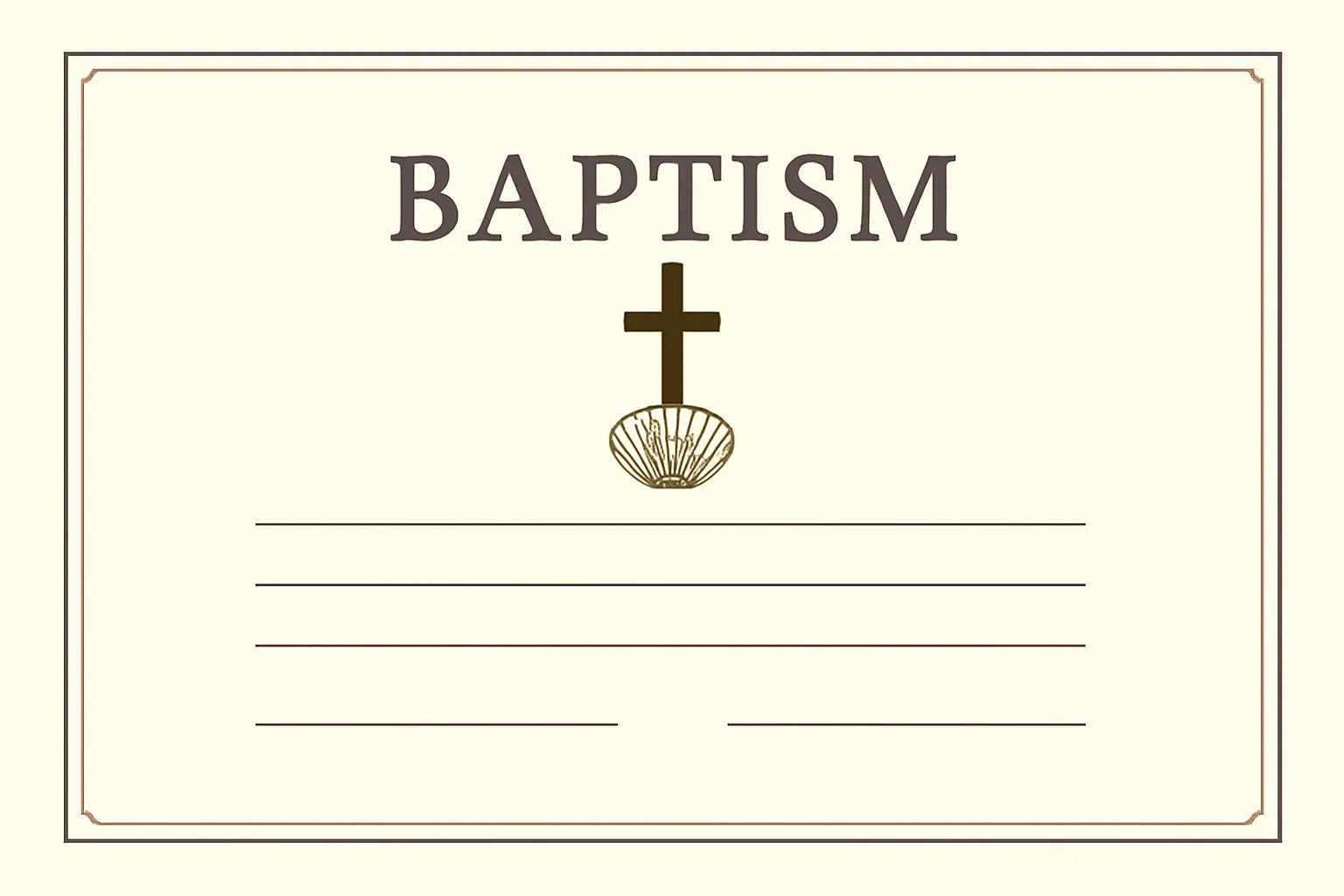
What is a Baptism Certificate Template for the Church?
A baptism certificate template designed for the church is a reusable framework that streamlines the process of documenting a sacred rite. Such a template serves as an official record that verifies that a baptism ceremony took place, who was baptized, when and where it occurred, and who officiated. When churches adopt a standardized approach, they ensure consistency across all certificates, making it easier for families to preserve a meaningful memory and for church archives to maintain orderly records.
The phrase Baptism Certificate Template Church – Free Printable & Customizable represents a category of tools that blends practicality with reverence. It is not merely a decorative document; it is a formal, legally or administratively useful record within many denominations. While some congregations prefer paper-only certificates, others maintain digital records that can be printed on demand. Regardless of format, a well‑designed template captures the key data and the aesthetic of the faith community.
Why use a Free Printable & Customizable Template?
Churches today frequently balance tradition with modern administration. A free printable baptism certificate template offers several important benefits:
Consistency across generations and parishes, maintaining uniform language and layout.
Accessibility for volunteer coordinators, administrators, and pastors who may need to issue certificates on short notice.
Cost savings when compared with bespoke, hand-illustrated certificates or custom design services.
Flexibility to customize fields, borders, fonts, and symbols to fit a denomination, season, or parish brand.
Compatibility with digital record-keeping systems and archives, enabling easy scanning and indexing.
A template designed for churches—sometimes marketed as church baptism certificate design or baptism certificate form—can be readily adapted to different liturgical calendars, sacramental language, and pastoral signatures. It also invites families to preserve a cherished milestone in a form that can be displayed, filed, or gifted, while still honoring the reverence of baptism.
Key Elements of a Baptism Certificate
Whether you call it a certificate of baptism, a baptism certificate template, or a church baptism certificate design, certain elements appear on nearly every official document. A well‑crafted template will accommodate all of these components:
Church name and denomination (if applicable)
Full name of the person baptized
Date of baptism (and, if relevant, time)
Location of the ceremony (sanctuary, baptismal font, or parish hall)
Officiating clergy or minister’s title and signature
Parents’ names or guardian’s names (if the baptism is infant or child baptism)
Names of witnesses or sponsors (where customary)
Church seal or embossed crest and, if used, certificate number
Statement of sacramental significance or a brief blessing text
Accreditation text (optional), such as “Certified by the Church Council” or equivalent
In a baptism certificate printable template, you may also include design motifs such as a dove, a water motif, or a subtle cross to convey sacred symbolism without compromising readability.
Sample field outline for a typical template
Church name and emblem
Certificate title (e.g., “Certificate of Baptism”)
Design considerations and branding for baptism certificate templates
Design plays a crucial role in making a baptism certificate template church feel meaningful while remaining legible and durable. Here are design considerations to guide your choices:
Tone and symbolism: Choose motifs (dove, water, cross, shells) that reflect the church’s tradition but avoid clutter.
Typography: Use readable fonts; combine a serif for the name and a sans-serif for data fields to create hierarchy.
Color palette: Select colors that align with the church’s branding or liturgical colors for the season (e.g., white for baptism, gold accents for solemnities).
Paper choice: Consider archival-quality paper with a neutral finish for longevity, or use heavy stock for a premium feel.
Security and authenticity: If needed, include a subtle watermark or embossed seal to deter forgery without complicating printing.
Layout balance: Ensure margins are ample so the certificate prints cleanly on standard paper without cropping.
Customization options for baptism certificate templates
A truly customizable baptism certificate template accommodates both baby-sponsoring families and mature individuals seeking a personal touch. Here are practical customization options:
Typography and readability
Choose a primary font for names and a secondary font for dates and details.
Allow bolding of the recipient’s name to emphasize identity.
Provide a version with larger font size for older worshipers or observers with visual challenges.
Fields and data blocks
Make fields optional or required based on denomination or archival policy.
Offer placeholders like [Full Name], [Date], [Location] to simplify filling out by hand or in a form.
Imagery and border options
Provide several border styles—classic, minimalist, or ornate—so churches can match their aesthetic.
Include a choice of emblem placements: centered seal, corner crests, or top banner.
Format choices
Printable PDFs for immediate use
Word or Google Docs templates for in-house editing
Adobe InDesign or Illustrator files for professional-grade printing
Free Printable & Customizable Template Resources: Where to Find
If you search for baptism certificate templates for churches, you’ll encounter a range of sources. It’s important to choose options that balance free access with quality and licensing clarity. Look for templates that offer:
Open licenses that permit reuse and modification by church staff
Formats compatible with common software (PDF, DOCX, AI, PSD, INDD)
Guidance on how to fill out fields and print with accuracy
Sample text in multiple languages if your congregation is multilingual
Clear notes about whether the template is suitable for infant baptism, adult baptism, or both
When using any free template, verify the license terms and ensure you have the right to alter text or graphics. If you need a more branded, church-specific solution, consider purchasing a customizable certificate design or commissioning a designer to tailor a church baptism certificate design to your denomination’s theological language and branding guidelines.
Variations across church traditions
The basic concept of a baptism certificate is shared across many Christian traditions, but the language and emphasis can vary. Below are a few notes on how the template may be adapted:
Catholic and Anglican contexts often require a formal tone, the officiant’s full title, and a reference to the sacramental nature of baptism.
Protestant and Evangelical traditions may emphasize personal faith statements or baptism by immersion as a public testimony.
Orthodox settings sometimes incorporate more liturgical language and may feature iconographic elements integrated into the certificate.
Inter-denominational designs may provide dual-language options or neutral phrasing to accommodate diverse families within a single parish.
Whatever the tradition, a strong template will keep the essential data intact while allowing denominational language to shine through in the blessing text and the signature lines.
Formats and how to use a baptism certificate template
Templates come in several formats, each with its own workflow. Here are common formats and practical usage tips:
PDF certificates: Ideal for printing on high-quality stock; preserve layout and typography across printers.
Word or Google Docs templates: Easy for volunteers to fill in fields by hand or digitally, with live editing.
Adobe InDesign or Illustrator templates: Best for multi-language text, advanced typography, and professional printing.
SVG/AI formats: Useful for scalable border designs and badges that can be integrated into other church materials.
To use a template, you typically download the file, customize the fields (name, date, officiant, etc.), save a print-ready version, and then print using your preferred paper and printer. If you’re distributing certificates to multiple families, consider creating a batch print workflow or a form submission process to minimize manual data entry.
Printing tips and material considerations
The physical certificate’s quality matters as much as its content. Here are practical tips for achieving attractive, durable results:
Paper stock: Use acid-free, archival-grade paper with a weight around 80–100 lb (120–150 gsm) or higher for a substantial feel.
Printer settings: For PDFs, use high-quality print settings, color management, and a printer that supports borderless printing if needed.
Color accuracy: If you’re using color inks for borders and seals, test print a sample to ensure colors reproduce faithfully.
Size and margins: Common sizes include letter (8.5×11) or A4; ensure margins leave room for signatures and the church seal.
Seals and embossing: If you include an embossed seal, consider a version without embossing for ordinary home printers or use a pre-embossed sheet from your stationery supplier.
For archival copies, maintain digital scans alongside printed certificates. This supports long-term preservation and simplifies future inquiries.
Legal and record-keeping considerations
Churches maintain baptism records for liturgical, pastoral, and historical reasons. A well-made Baptism Certificate Template helps support proper record-keeping, but you should be mindful of privacy, theological language, and archival practices. Key considerations include:
Privacy: Limit sensitive information in the certificate to what is appropriate for public display; store more detailed data in confidential parish records.
Authenticity: Use official signatures and, where possible, a church seal or watermark to deter forgery.
Retention policies: Align certificate formats with the church’s archival standards and the denomination’s guidelines.
Legal clarity: Ensure wording respects canonical or doctrinal statements, particularly if the document serves as a public record within the community.
If your church uses a centralized database, the template can feed data into that system, ensuring consistency between the physical certificate and the digital record.
Sample wording and language for a baptism certificate
The exact wording will vary by tradition, but the certificate should be respectful and informative. Here are example fragments that may appear within a baptism certificate template:
“This is to certify that on the [date] day of [month], in the year [year], [Recipient’s Full Name] was baptized according to the rites of the [Church Name].”
“In the name of the Father, and of the Son, and of the Holy Spirit, this baptism was administered by [Officiant’s Name, Title].”
“Witnessed by [Names] and sealed with the authority of this congregation.”
“Dove and water motifs symbolize the cleansing of sin and new life in Christ.”
For infant baptisms, you may include a line about parental/guardian roles and godparents, such as: “Parents/Guardians: [Names]; Godparents: [Names].” If appropriate, include a blessing at the end: “May this child grow in faith and grace.”.
Accessibility and inclusivity in certificate design
Accessibility improves usability for all recipients, families, and church staff. A baptism certificate template should consider readability and inclusive language:
Use high-contrast text with readable font sizes and sufficient line spacing.
Provide alternative text (alt text) for any decorative imagery if the certificate is distributed as a digital file.
Offer translations or bilingual versions where your congregation is multilingual.
Include a clear, straightforward layout so that volunteers can fill in data without confusion.
Define the essential data fields (name, date, location, officiant, signatures) based on your denomination’s requirements.
Choose a layout that accommodates your emblem and seal while leaving room for signatures.
Select a typography system with a clear hierarchy: a prominent name, secondary details, and a legible date line.
Design or select a border motif that aligns with church branding but remains unobtrusive.
Prepare separate layers or text blocks for fields so staff can swap values easily.
Export in multiple formats (PDF for printing, DOCX for editing) and test print on different printers.
If you’re using design software like InDesign or Illustrator, you can create reusable components: a header area for the church seal, a body block for data, and a footer for signatures and date. For churches with limited design resources, a well-structured Word or Google Docs template can be a practical alternative, especially when paired with a printable PDF version for final production.
Common mistakes to avoid
To ensure the final document is both respectful and professional, watch out for common issues:
Overly busy borders that crowd the recipient’s name or vital data.
Inconsistent date formats or missing time references where relevant.
Unclear signature lines or unlabeled stamps/seals.
Small or cramped font sizes that hinder readability.
Using copyrighted imagery without permission; prefer royalty-free or church-owned insignia.
Final checklist for churches adopting a baptism certificate template
Before you begin printing and issuing, run through this quick checklist:
Confirm the required fields with pastoral leadership or the church registrar.
Verify the branding guidelines—logo usage, color palette, and typography.
Test print on your chosen paper stock to ensure alignment and edge-to-edge accuracy.
Prepare a digital copy of the certificate for archiving and easier distribution.
Assign a designated person or team to handle requests, filling, and signing.
Secure a signature and seal process consistent with church policy.
A practical example of a complete template concept
To illustrate what a baptism certificate template church might include in a single, coherent document, consider this conceptual layout:
Header: Church name, crest, and a brief liturgical phrase.
Title: “Certificate of Baptism” prominently displayed.
Recipient information: Full name in larger type; optional birth date.
Event details: Date, location, and officiant’s name/title.
Parental or sponsor details: If infant or child baptism, names of parents and sponsors.
Witness lines: Optional signatures or initials of witnesses.
Seal area: Space for church seal or embossing.
Blessing text: Short, meaningful line that affirms the spiritual implications of baptism.
This example demonstrates how a balanced combination of data fields and reverent design can be structured in multiple formats, while keeping the document legible and dignified for families.
Variations on terminology and semantic breadth
In writing about a baptism certificate template for a church, you’ll encounter a range of synonyms. To maintain semantic richness and improve searchability or readability, you can refer to the document as:
baptism certificate design for churches
church baptism certificate paper
baptism certificate form for a parish
baptism certificate sample with seal
free printable church baptism record
customizable baptism document for ministry
baptism certificate template for parish records
Using these variations helps maintain a natural flow in articles, guides, or tutorials while keeping the focus on the core purpose: a formal, meaningful baptism record that reflects a community’s faith and identity.
Putting it all together: why communities choose a flexible, free, and customizable approach
A free printable & customizable template offers a pragmatic path for churches of all sizes. It empowers volunteers to issue certificates quickly, preserves the sanctity of the rite, and supports archival integrity. The templates are not one-size-fits-all; they are designed to be adapted to your church’s language, art, and liturgical preferences. A good template respects variability in language, accommodates multiple languages, and remains faithful to the spiritual meaning of baptism while providing a durable, professional artifact for families to treasure.
In the end, a well-constructed Baptism Certificate Template Church—whether seen as a template, a form, or a sample certificate—should resonate with the congregation’s values, support reliable record-keeping, and honor the sacred moment of baptism for every believer who receives it.
Baptism Certificate Template Church – Free Printable & Customizable stands as a practical banner for parishes seeking both reverence and efficiency in their sacramental documentation.

 Por Laura Jara